Report #8 · Dragon Warrior I–IV · Final Fantasy I–III · 8-bit originals
Cartridge Constraints
Why is Zoma's HP exactly 1,023? We read the monster tables out of seven 8-bit cartridges and measured every number against the size of the box it's stored in — to see which limits belonged to the hardware, which the designers chose, and what happened once the remakes took the lid off.
1How big were the boxes?
Every monster in these games is a short row of bytes on the cartridge. How many bits each number gets decides the biggest value it can ever hold: 8 bits stop at 255, 10 bits at 1,023, 16 bits at 65,535. We read the monster table out of each cartridge and worked out the width of every field from the game's own code.
Dragon Warrior I and II give almost every combat stat a single byte (DW2's EXP gets 12 bits). Dragon Warrior III and IV squeeze HP, attack, defense and gold into 10 bits each, borrowing two spare bits from elsewhere in the record, so a monster tops out at 1,023. Final Fantasy gives HP a full 16 bits from the start, and Final Fantasy II doesn't store most stats at all: it stores a slot number into a short list of allowed values.
Dragon Warrior grew from 8-bit to 10-bit monsters; Final Fantasy started at 16 bits, or used lookup slots
Storage width of each monster field, in bits (FF2: width of the slot number into a lookup table; blank = not stored)
In Dragon Warrior III the two extra bits for HP, attack, defense and gold sit further along the same 23-byte record. Every width above was confirmed by decoding the whole table and checking known values from reference guides.
2Who is pressed against the lid?
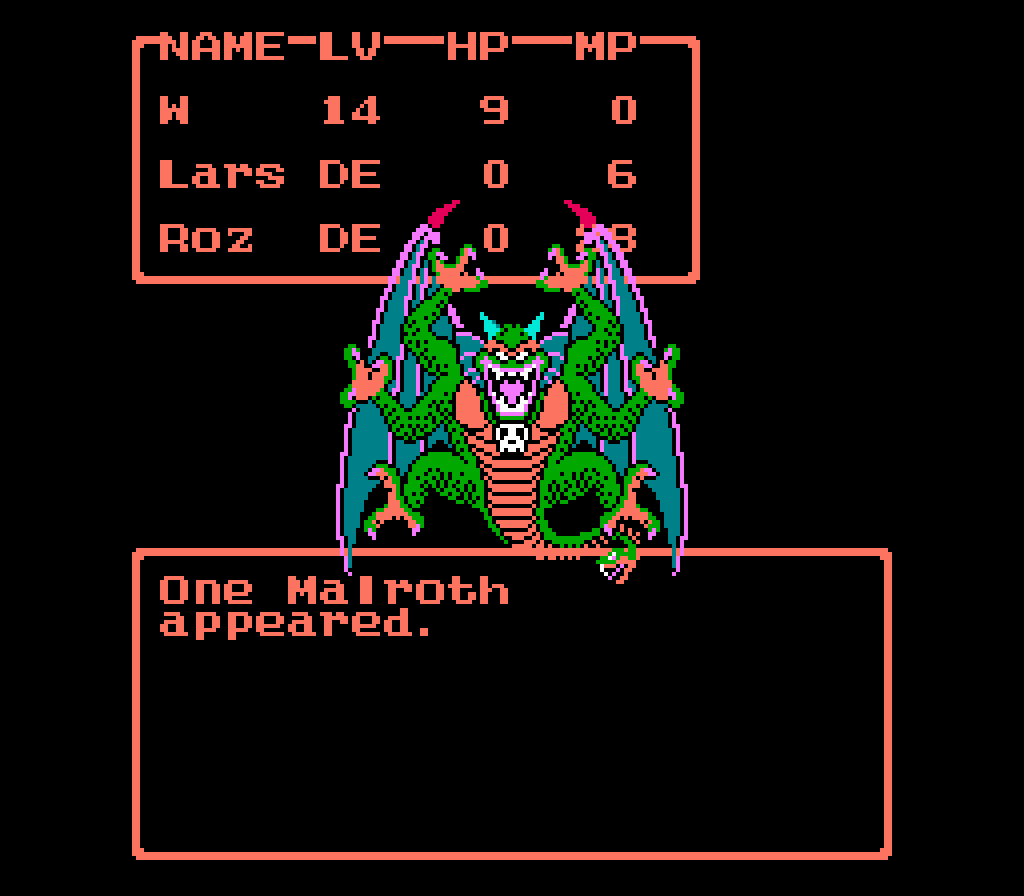
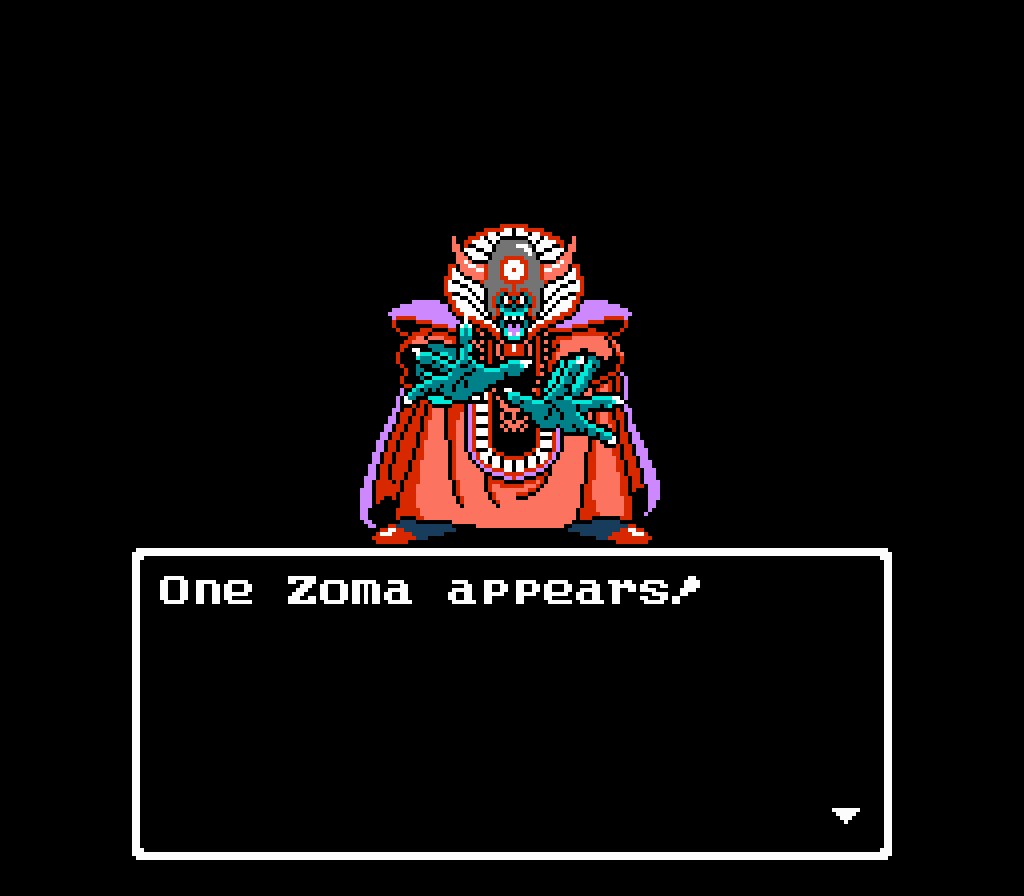
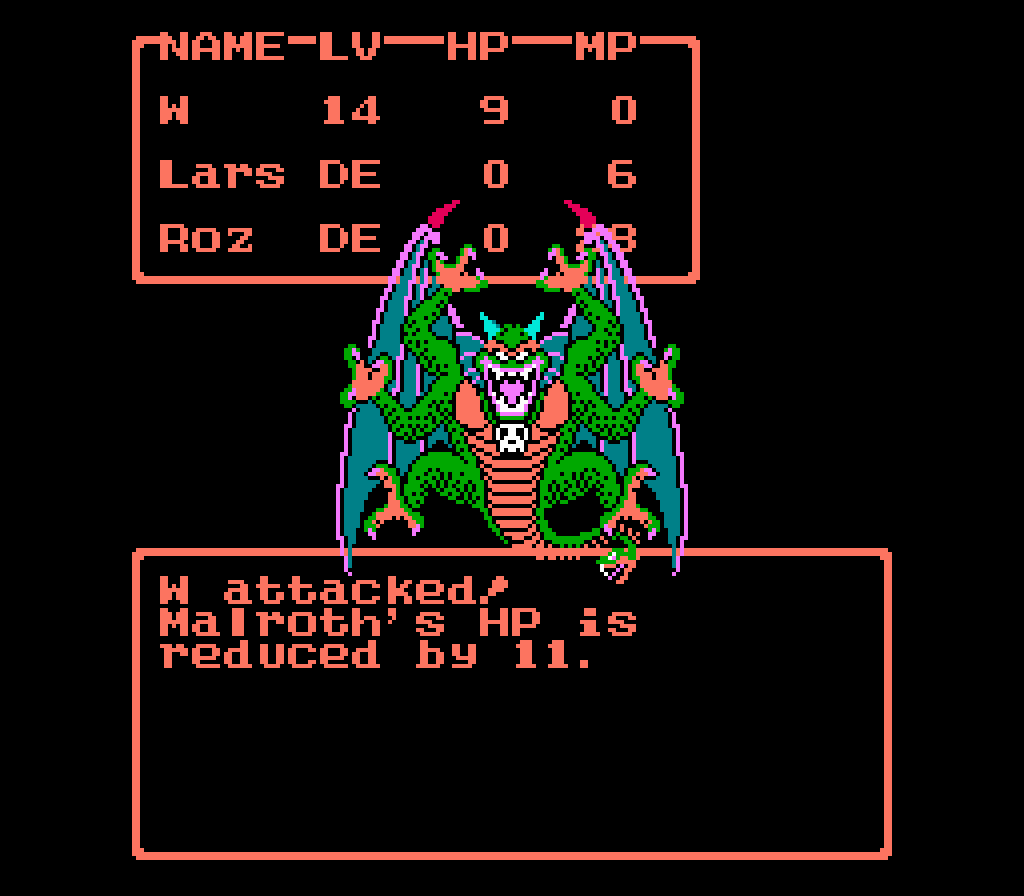
A number that exactly fills its field — 255 in a byte, 1,023 in ten bits — is a number the designers couldn't have raised by even one. Dragon Warrior III and IV are full of them: both Zoma forms at 1,023 HP, every metal slime at 1,023 defense, Baramos at 65,535 EXP. In Dragon Warrior II, Malroth's attack and defense are both 255, and the final four bosses sit at 250 HP of a possible 255 in the table. In battle each one starts a random amount lower: replaying the published speedrun, Malroth appeared with 189 HP, and every hit on him added up to exactly that.
The lid is crowded in Dragon Warrior III and IV — and in FF1's morale byte
Number of monsters whose value exactly fills its field, by game and field (FF2: the last slot of its lookup table)
Dragon Warrior NES, North America 1989
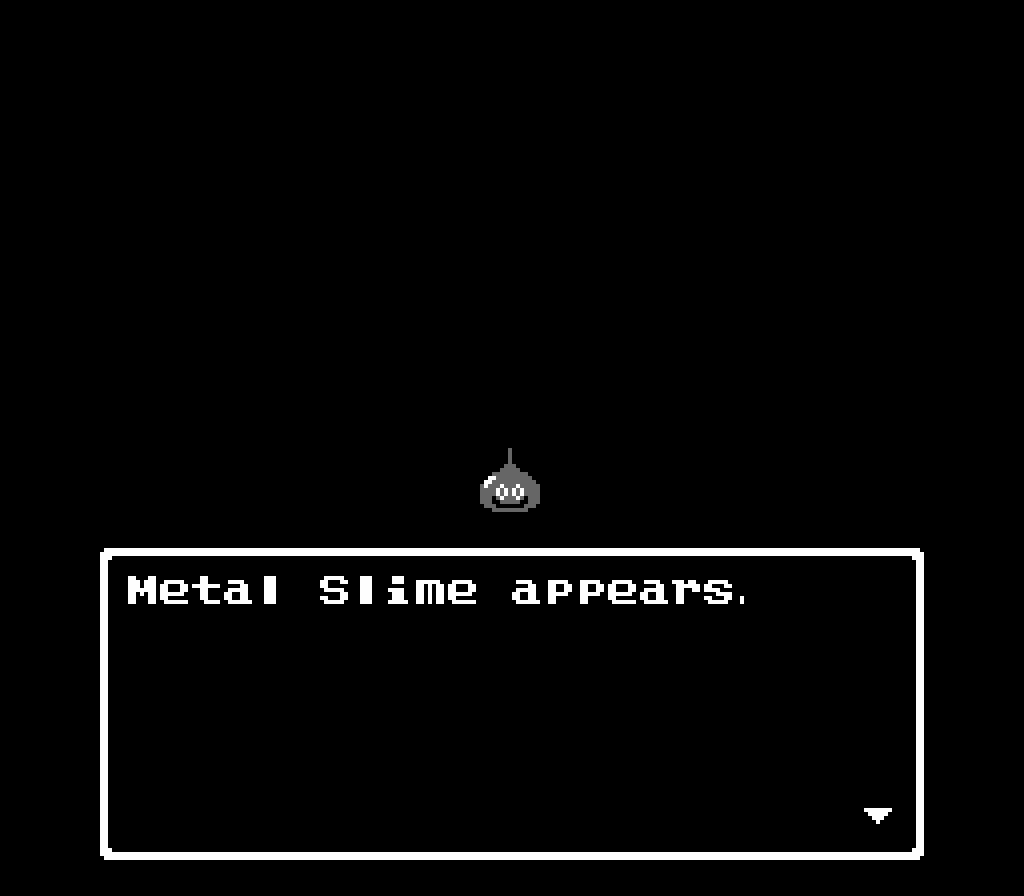
- Defense 255 (8-bit): Metal Slime
Dragon Warrior II NES, North America 1990
- Attack 255 (8-bit): Malroth
- Defense 255 (8-bit): Metal Babble, Malroth
- Gold 255 (8-bit): Gold Orc, Metal Babble, Zarlox
Dragon Warrior III NES, North America 1992
- HP 1,023 (10-bit): Zoma, Zoma Weakened
- Defense 1,023 (10-bit): Metal Slime, Metal Babble
- Agility 255 (8-bit): Zoma
- MP 255 (8-bit): Healer, Trick Bag, Curer, Evil Mage, Dancing Jewel, Voodoo Warlock and 5 more
- EXP 65,535 (16-bit): Baramos
- Gold 1,023 (10-bit): Dancing Jewel, Gold Basher
- Level 63 (6-bit): Orochi, Red Slime, Baramos Bomus, Baramos Gonus, Baramos, Zoma and 5 more
Dragon Warrior IV NES, North America 1992
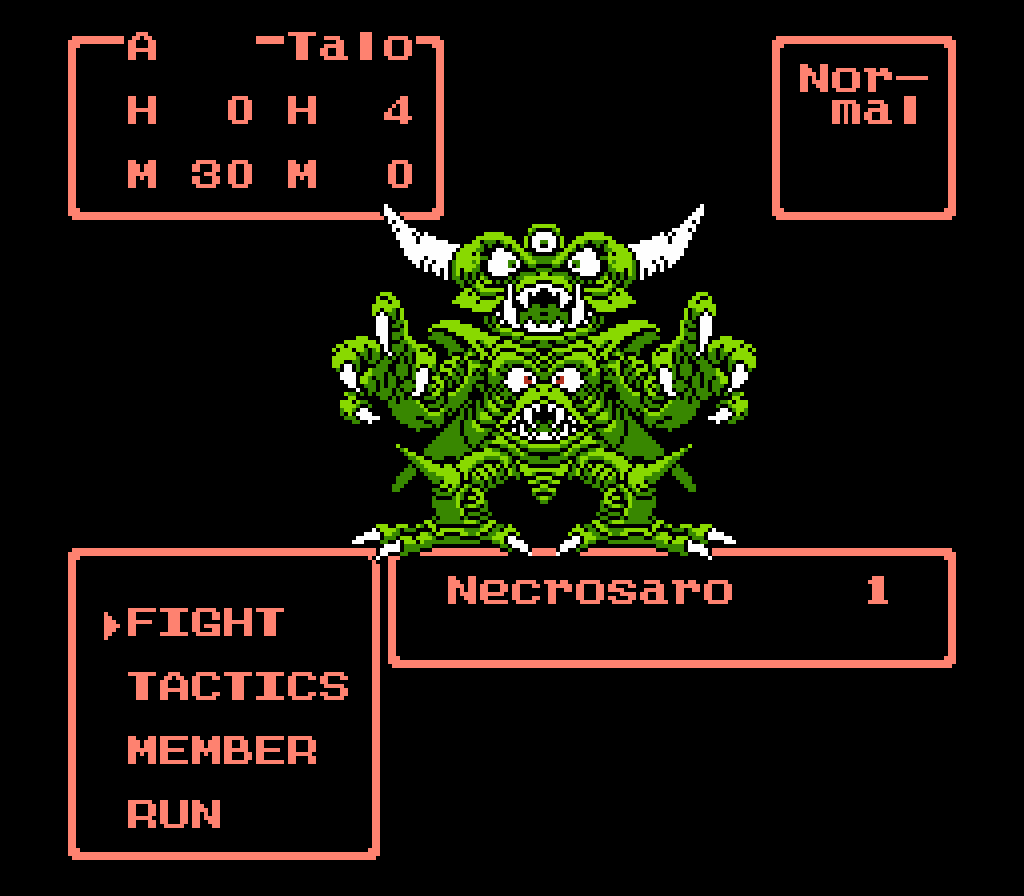
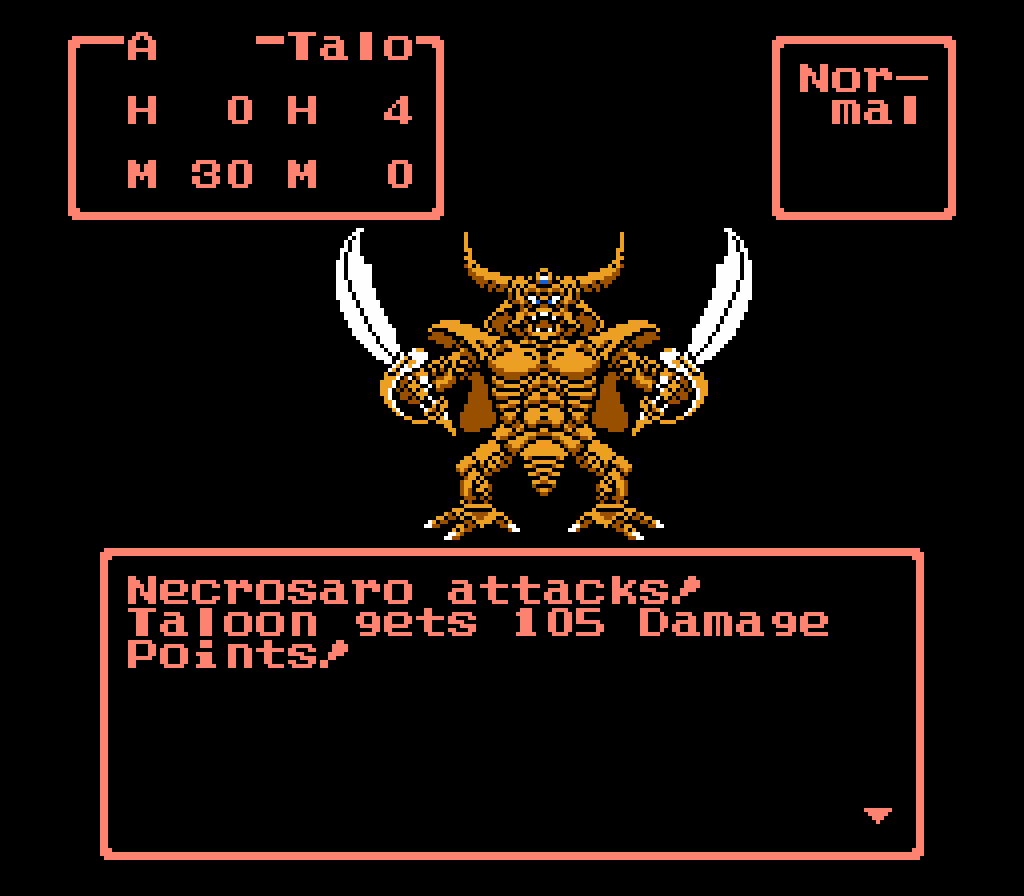
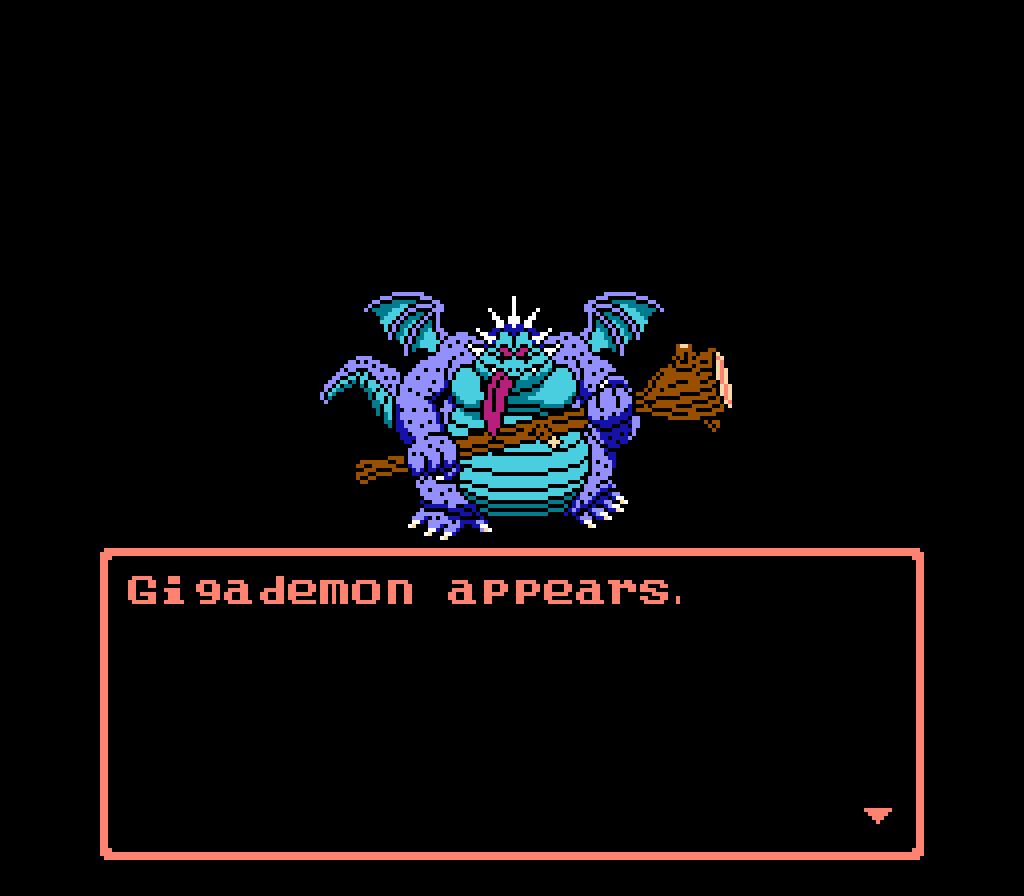
- HP 1,023 (10-bit): Master Malice, Gigademon, Necrosaro (Stage 3), Necrosaro (Stage 7)
- Defense 1,023 (10-bit): Metal Slime, Metal Babble, King Metal
- MP 255 (8-bit): Healer, Mystic Doll, Curer, Metal Babble, Clay Doll, King Healer and 14 more
Final Fantasy NES, North America 1990
- Defense (absorb) 255 (8-bit): SCUM, SLIME
- Morale 255 (8-bit): PIRATE, GARLAND, ASTOS, LICH, LICH, KARY and 6 more
Final Fantasy II Famicom, Japan 1988
- HP 10,000 (5-bit slot): Empire
- Defense 210 (4-bit slot): Slime, Jelly, Jam, Pudding, Empire
Final Fantasy III Famicom, Japan 1990
- Attack 255 (8-bit): Two-Headed Dragon
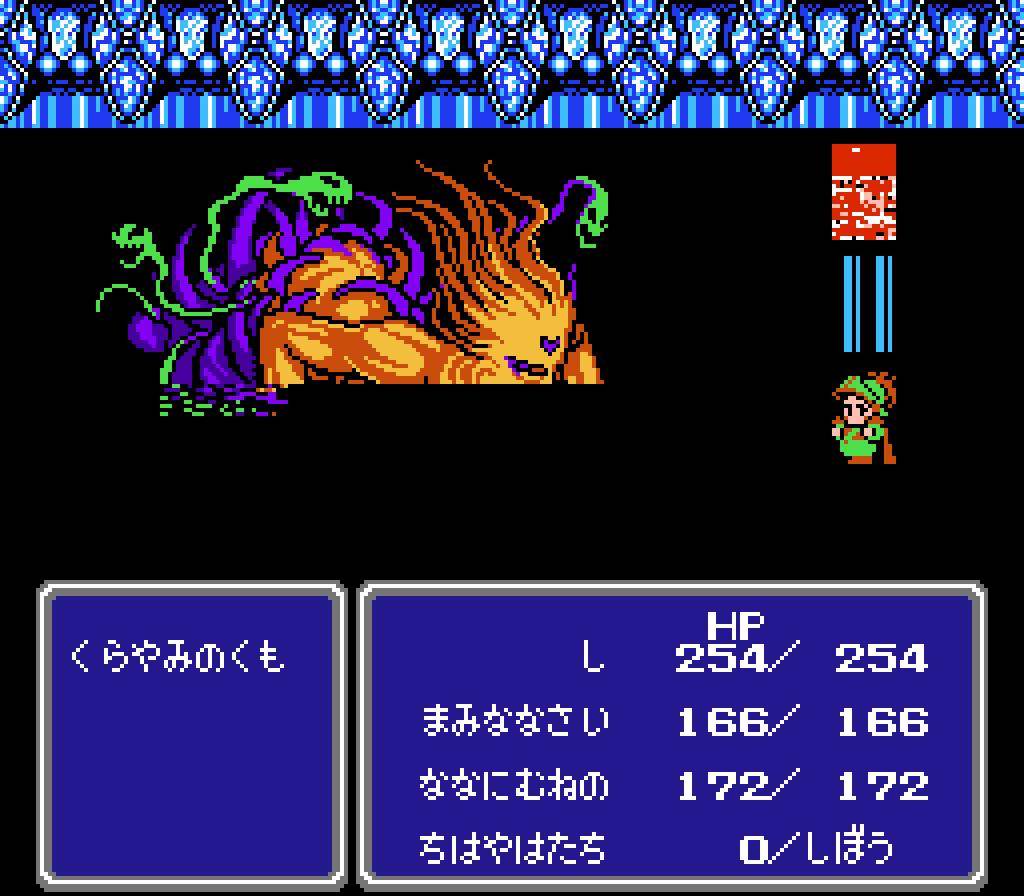
- Defense 255 (8-bit): Cloud of Darkness (first, scripted fight)
- Magic defense 255 (8-bit): Cloud of Darkness (first, scripted fight)
- EXP 9,000 (6-bit slot): Ahriman
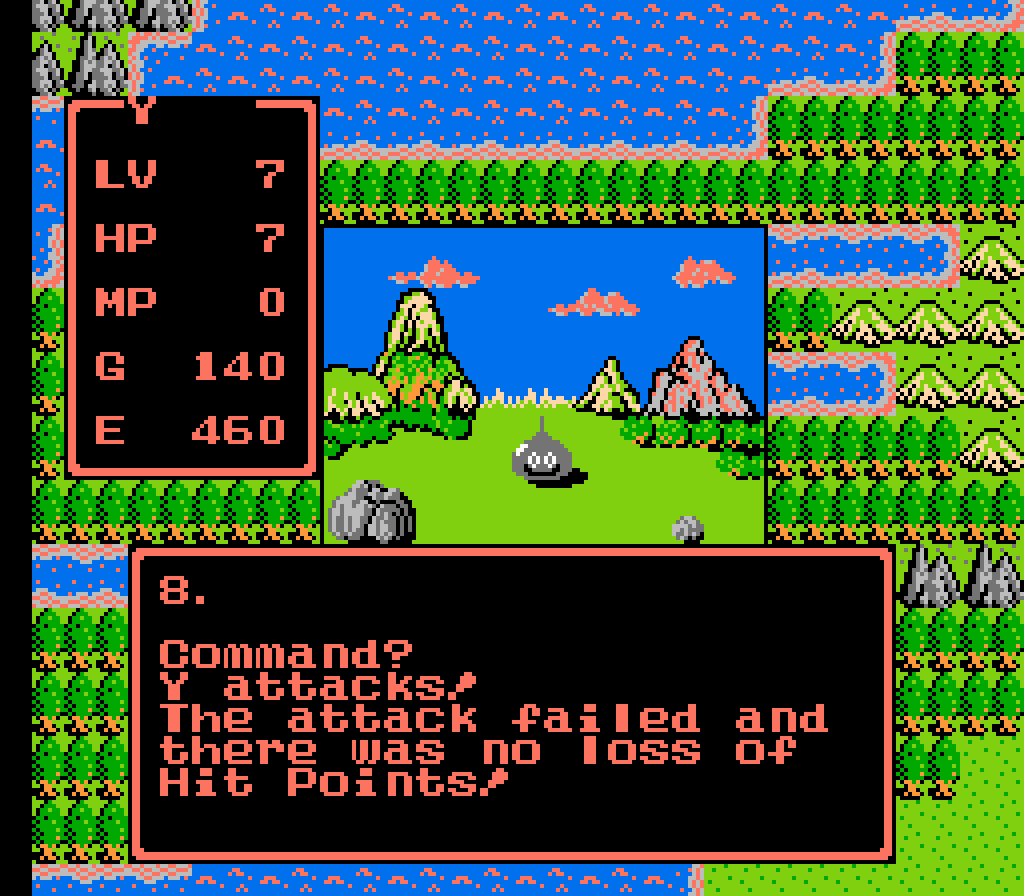
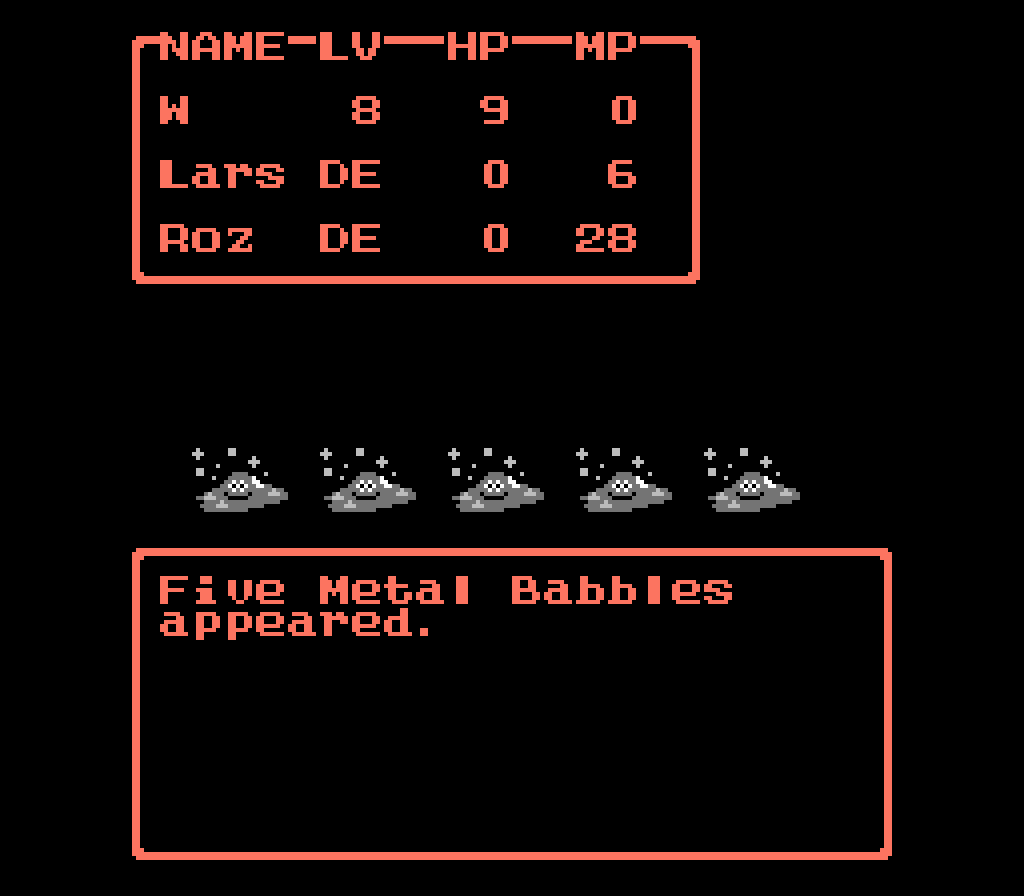
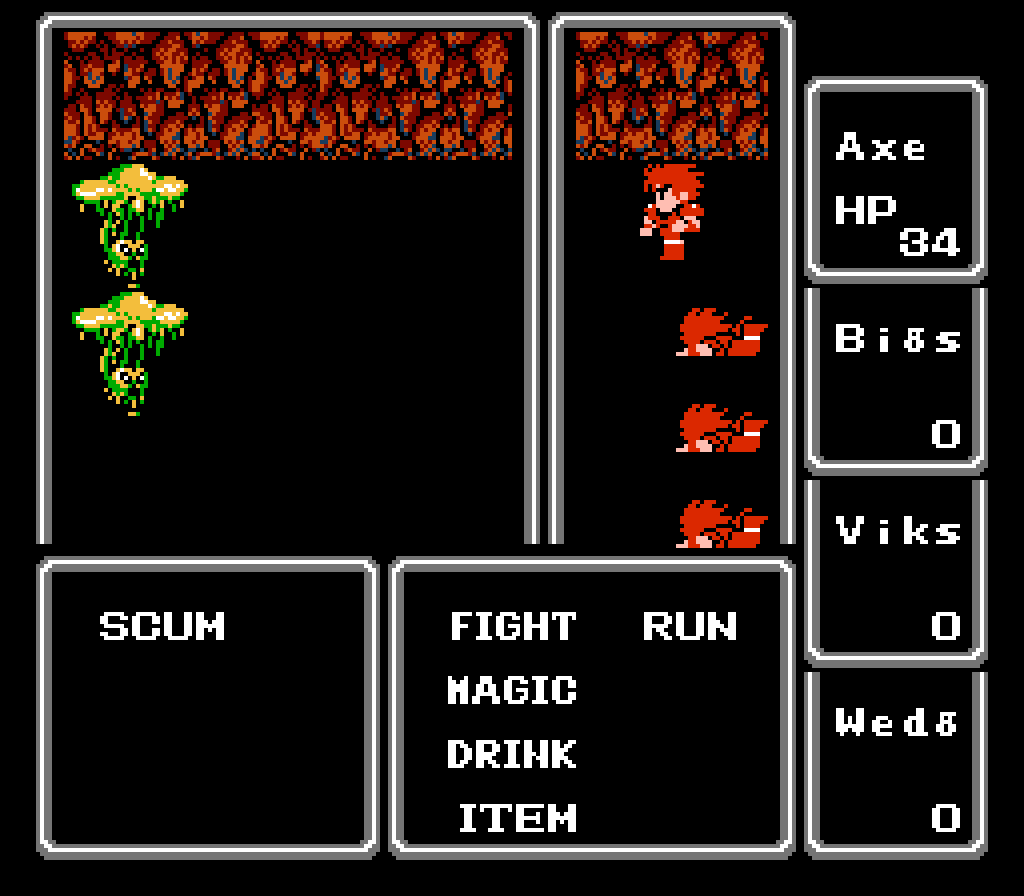
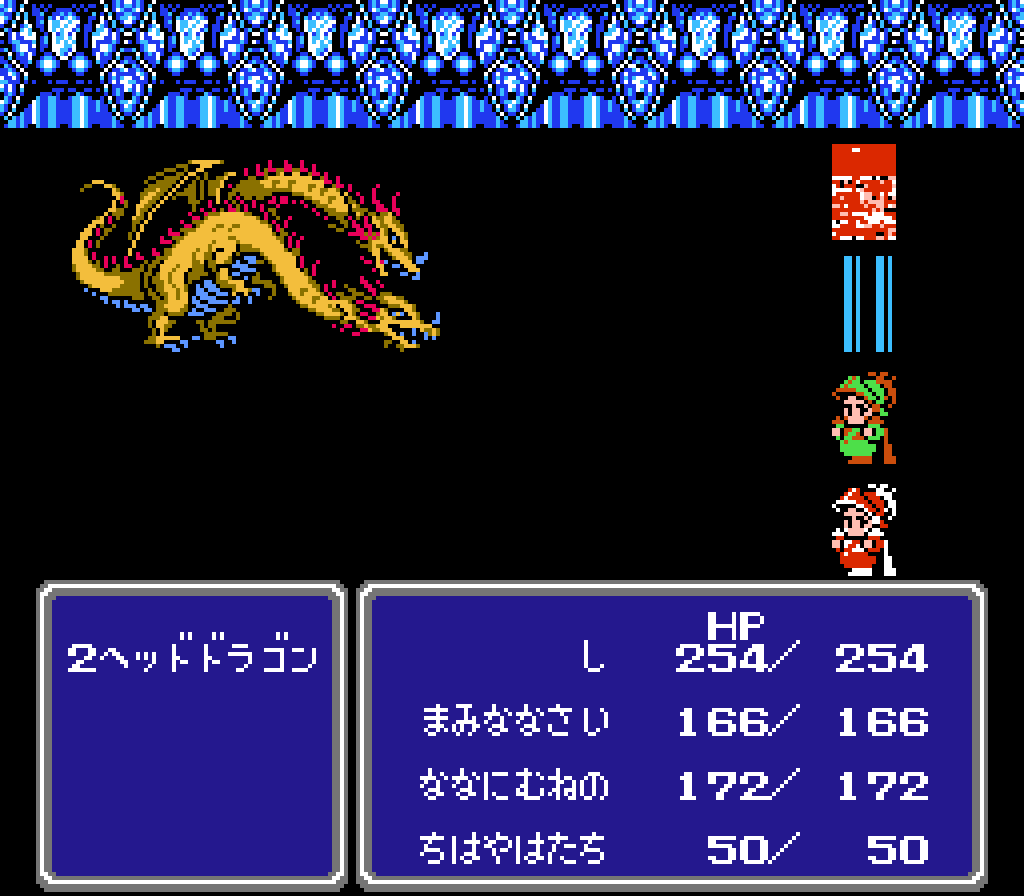
MP 255 in Dragon Warrior III and IV is worth a note: fan references describe 255 as "infinite MP" in these games. We haven't confirmed that meaning in the code, so the page counts it only as a full byte.
3A wall, or a choice?
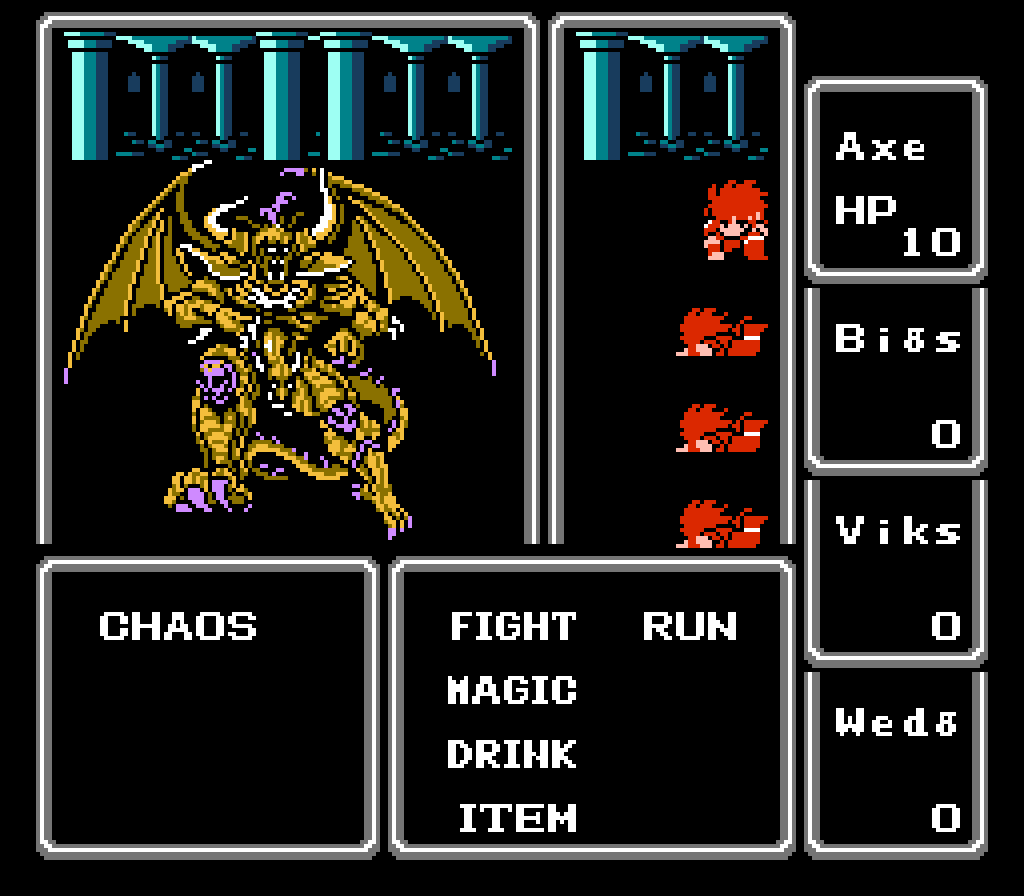
The two series treat their limits differently. Enix's strongest monsters sit exactly on the storage ceiling — Zoma and Necrosaro at 1,023, the most ten bits can hold. Square's strongest monsters stop on round numbers well inside the box: Chaos at 2,000 HP in a field that could hold 65,535, Final Fantasy II's Emperor at 10,000 (the last entry Square wrote into its HP list), and Final Fantasy III's biggest record at 65,000 rather than 65,535. That record is the Cloud of Darkness's first, scripted appearance, with defense and magic defense both at 255; the final battle loads a separate record with 45,000 HP.
Enix filled the HP field to the last bit; Square stopped at round numbers
The strongest monster's HP as a share of the largest value its HP field can store
- Dragon Warrior (Enix)
- Final Fantasy (Square)
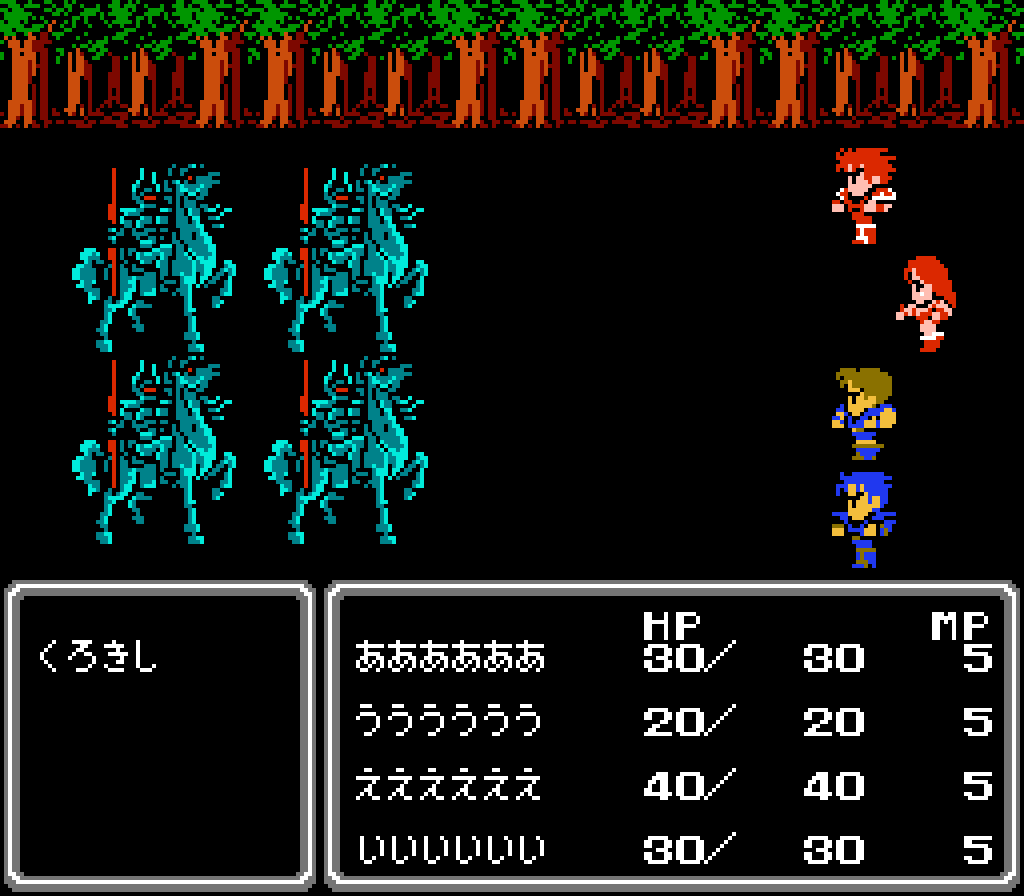
Final Fantasy caps the party the same way. The code stops hit rate, magic defense, damage and evade at 200, stats at 99, HP at 999 and gil at 999,999 — clamps chosen by the designers, well below what the bytes could hold. The first Dragon Warrior clamps where its storage ends: gold and EXP stop at 65,535, and level 30 needs exactly 65,535 EXP. By Dragon Warrior III, Enix used round-number clamps for the party too: gold stops at 99,999 and EXP at 9,999,999. FROM CODE
4What happened when the lid came off?
The remakes moved to hardware where a monster's HP could run into the thousands. Every final boss got bigger — but not by the same amount. The Dragonlord's true form grew 37×; the Emperor only 1.5×. And one number went the other way: freed from its byte, Malroth's attack dropped from 255 to 235 in the Super Famicom remake, before HD-2D raised it to 369.
Freed from their limits, final bosses grew from 1.5× to 37× — and Malroth's attack went down
Final-boss HP: original cartridge (read by us) → first remake → latest release (reference sites), log scale
- Dragon Warrior / Dragon Quest
- Final Fantasy (dashed)
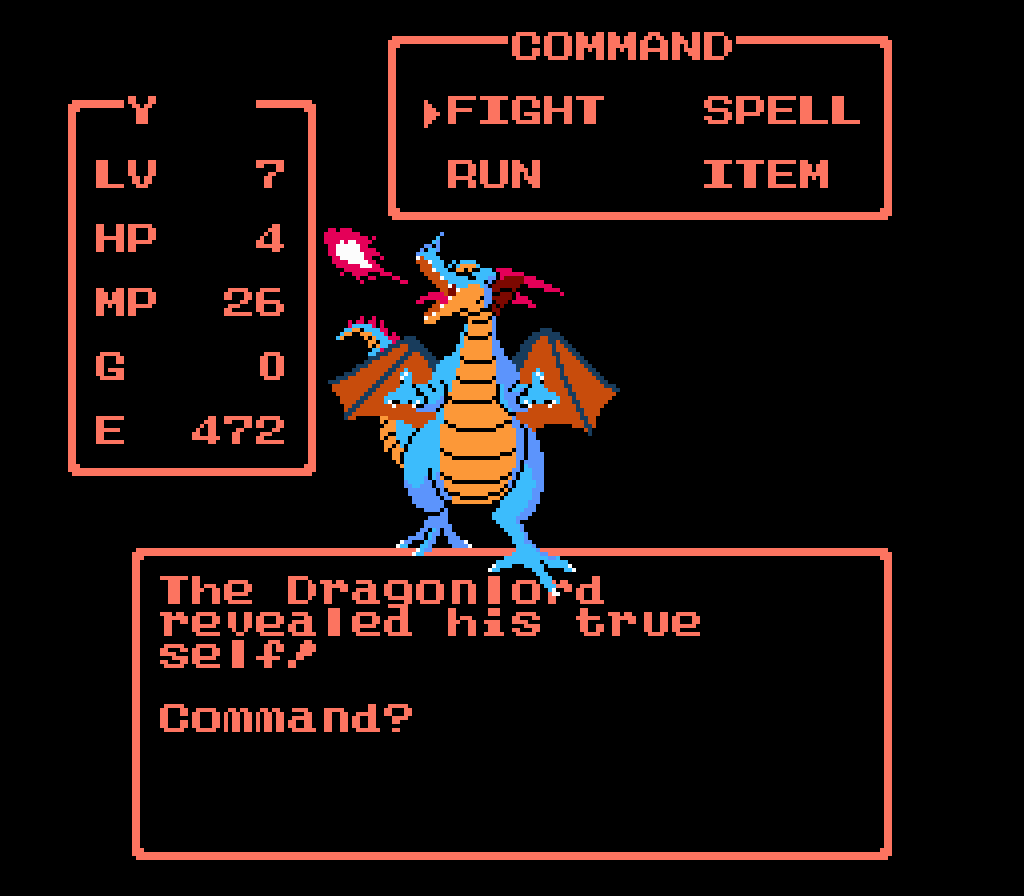
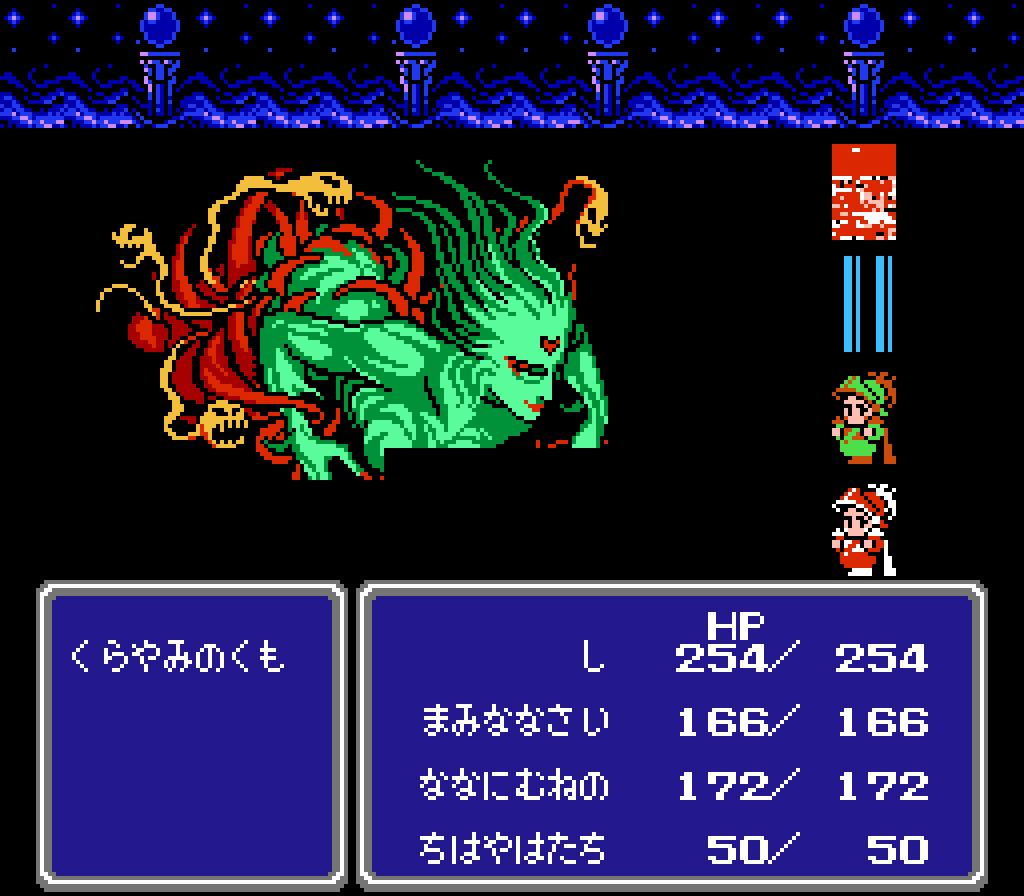
Remake values are reference-site data, labeled REF in the table; we have no remake cartridges except Dragon Warrior III's Super Famicom version. The PlayStation Dragon Quest IV listing repeats 1,023 for Necrosaro's final stage; it comes from a reference site and we haven't checked it against that disc. PSP lists three Emperor records; the chart uses the highest.
5Eight letters
Final Fantasy gives each monster name eight characters. In Japanese kana that's usually enough; in English it's a squeeze. The US Final Fantasy abbreviated its way through the bestiary — MANTICOR, COCTRICE, NITEMARE — and the unreleased English prototype of Final Fantasy II fills all eight on 68 of its 128 names, often by chopping: LegEater, VmpThorn, QueenBee, Big Foot, Stalacti, Sprinter.
More than half of the FF2 prototype's English names use all 8 letters
Share of monster names that use all 8 characters of the name field
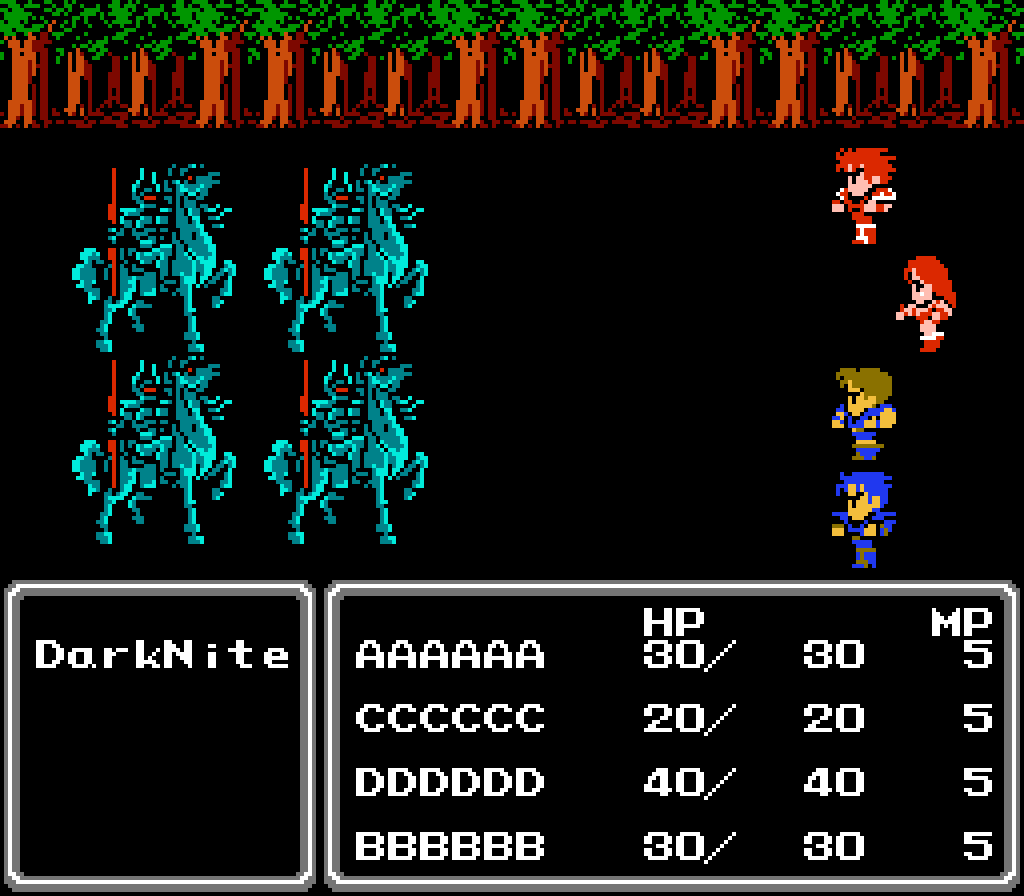
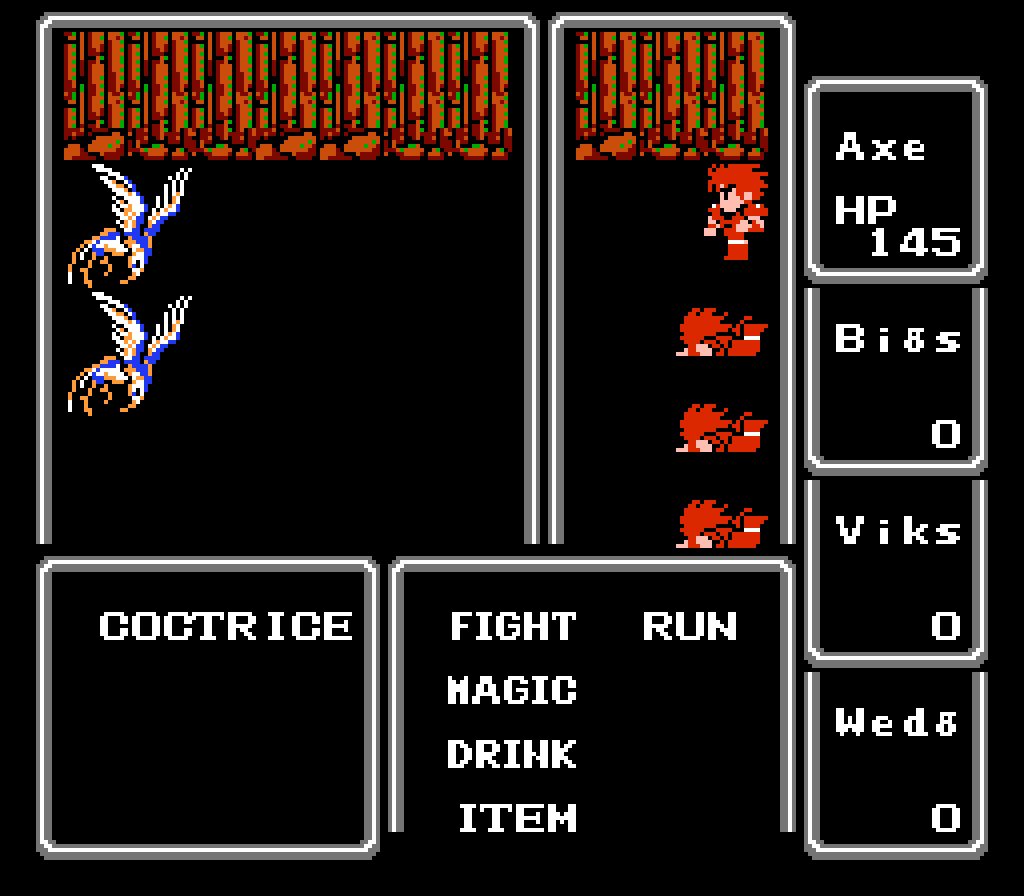
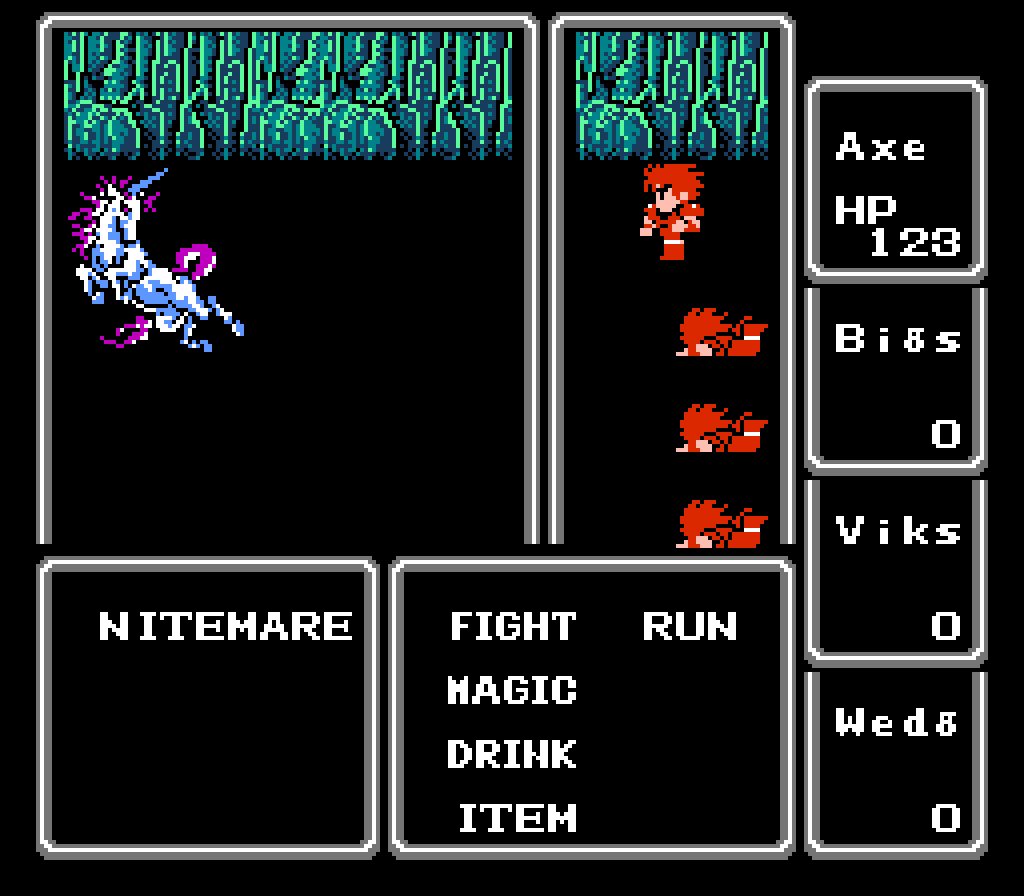
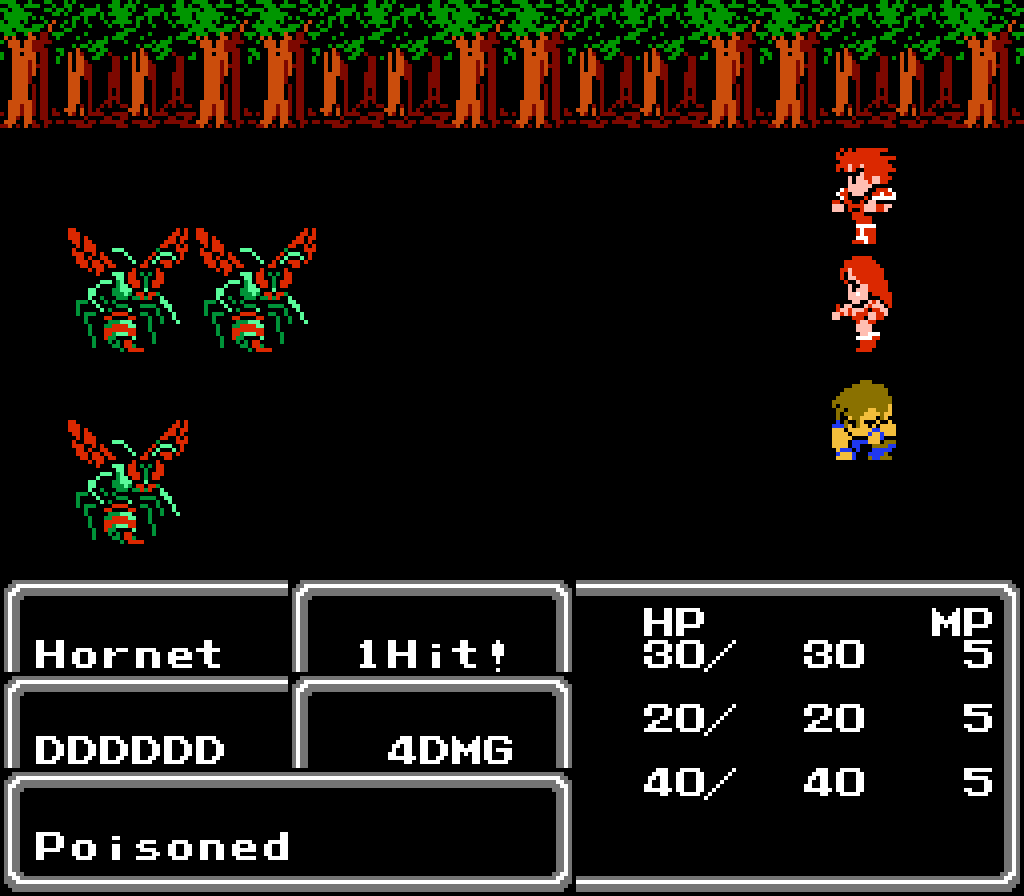
Hero names were tighter still. Final Fantasy's heroes get four characters. Dragon Warrior stores eight, but its status window shows only the first four, and only those four feed the name-based bonus to the hero's stats. FROM CODE
6Bugs at the edge
Ceilings attract bugs: code that packs a number into a few bits has to unpack it the same way everywhere. Reading the tables turned up a handful of places where the code and the limit disagree. Each is graded by how we know it.
The attack read that looked like a bug — and wasn't one in play
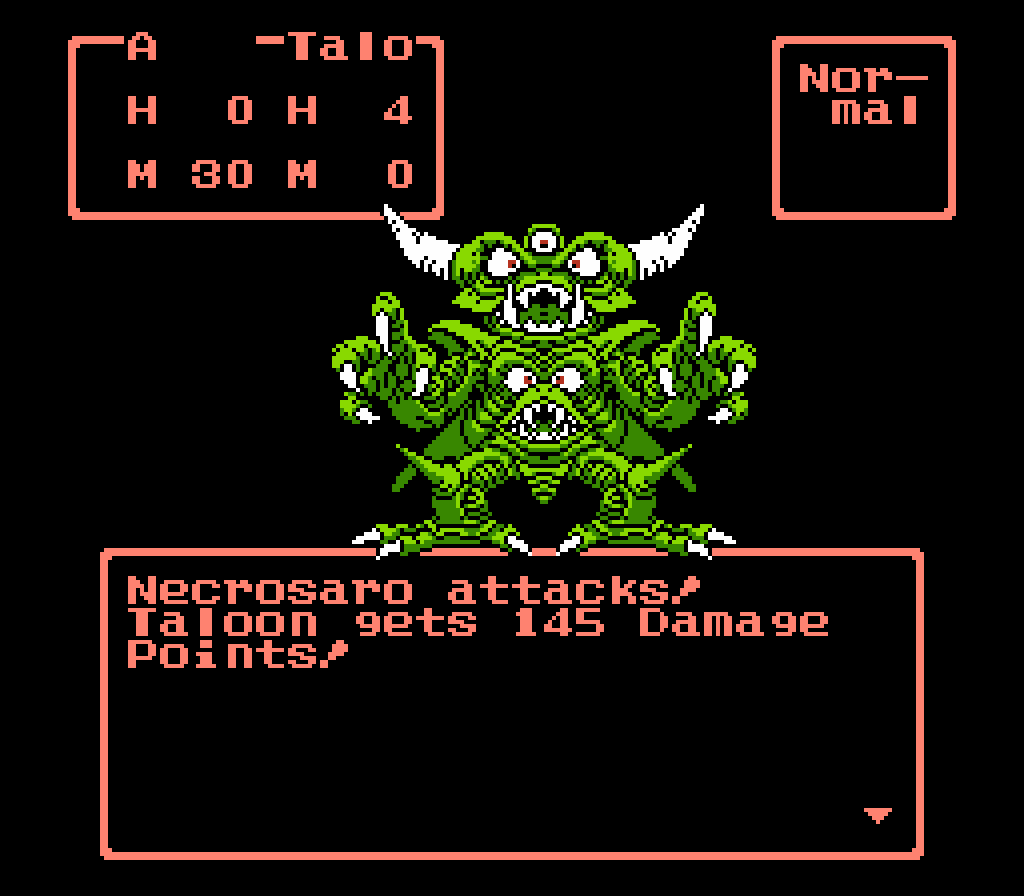
DW4 stores monster attack in 10 bits: a low byte plus two high bits kept in byte 16 of the record. The routine at $85E3 reads those high bits and masks them with AND #$02, where the matching defense routine uses AND #$03, so attack 290 (high bits 01) would come back as 34.
Tested in play: Necrosaro hits with attack 290. All 166 hits from stages 6 and 7 in our runs fit 290, none fit 34, and battle memory holds 290.
Dragon Warrior IV (NES US; identical in both Famicom dumps), bank 16 $85E3-$85FE, AND #$02 at $85F3. Replayed TAS 5288M on BizHawk 2.9 with our own button presses branched from its save states; memory only read. The battle loader (bank 16 $A456-$A4F8) reads attack with AND #$03; what uses the AND #$02 routine is still unknown.
1,023 becomes 1,200 — then 1,023 again
When a monster is loaded, DW4 checks whether its table HP is exactly 1,023, the 10-bit maximum, and swaps in 1,200. Gigademon and Necrosaro's third and final stages all enter battle with 1,200 HP in memory. But before the first hit lands the game cuts current HP back to 1,023, so in every fight we logged the extra 177 HP never existed.
Observed in battle memory: 1,200 at load, 1,023 before any damage, in the TAS and in our branches. The code that cuts it back has not been found.
Dragon Warrior IV (NES US), bank 16 $A496-$A4AA: LDA $7E / CMP #$FF / LDA $7F / CMP #$03, then LDA #$B0 (1,200 = $04B0). TAS 5288M on BizHawk 2.9, observe-only; no live HP between 1,024 and 1,199 appears in any log.
An EXP cap that writes the wrong number
The EXP cap subtracts 9,999,999 (0x98967F) to test the total without first setting the carry flag, and when it caps, it stores 0x98997F: 10,000,767 instead of 9,999,999. The middle byte is 0x99 where 0x96 belongs.
Final Fantasy III (Famicom), file 0x6BE70-0x6BE8F (SBC #$7F/#$96/#$98, then LDA #$98 / #$99 / #$7F). We read these instructions in our own dump. Seeing it happen needs ten million EXP, far beyond what an input-only run here can reach.
A gold cap that only half-checks
After adding a reward, the cap routine exits early only when the top byte of the gold total is lower than the limit's. When the top byte is higher, it goes on to compare the middle and low bytes anyway, so a total such as 1,065,535 isn't recognised as over the 999,999 cap.
Final Fantasy (NES), AddGPToParty, bank_0F.asm lines 7238-7281 (Entroper disassembly). Flagged in the disassembly and visible in the code; normal play never adds enough gold at once to trigger it.
Found while reading: the US Dragon Warrior II is a different balance
The other tables we read match their Japanese originals byte for byte: Dragon Warrior I, III and IV and Final Fantasy I and II. Dragon Warrior II doesn't. 43 of its 82 monsters differ, and almost always in the player's favour: 40 give more EXP in the US version (median ×1.30), none give less, and a few early monsters were weakened — the first Slime lost 1 HP and 1 attack.
The US Dragon Warrior II pays more EXP: 40 monsters raised, none lowered
EXP per monster, Famicom (Japan) vs NES (North America), for the 16 highest-EXP monsters that changed
- Famicom (Japan)
- NES (North America)
Ceiling Explorer
Pick a game and a field to see every monster's value drawn against the largest number that field can store.
HP is a 10-bit field, so it can hold at most 1,023. 2 of 139 monsters sit exactly on that ceiling.
- Zoma1,023 ▲
- Zoma Weakened1,023 ▲
- Baramos Gonus900
- Baramos900
- King Hydra550
- Bomb Crag500
- Kragacles450
- Baramos Bomus450
- Ortega400
- Kandar II400
- Granite Titan350
- Putregon350
- Boss Troll320
- Orochi300
- Troll250
- Troll King250
- Mimic240
- Gold Basher210
- Tentacles200
- Salamander200
- Scalgon200
- Stone Hulk195
- Ghoul170
- Swordoid170
- Lionroar160
- Voodoo Warlock150
- Darthbear150
- Hydra150
- Kandar150
- Glacier Basher140
- Leona140
- King Squid135
- Marauder130
- Vile Shadow130
- Archmage130
- Winged Demon125
- Man-Eater Chest120
- Eliminator120
- Voodoo Shaman120
- King Tortragon120
- King Merzon120
- Green Dragon120
- Avenger115
- Lionhead115
- Grizzly110
- Snow Dragon110
- Hades' Condor100
- Magiwyvern100
- Hork98
- Evil Mage95
- Kong95
- Witch Doctors93
- Barog93
- Fierce Bear90
- Elysium Bird90
- Hologhost85
- Deranger80
- Sky Dragon80
- Venom Zombies80
- Wyvern80
▲ = exactly at the field's ceiling. Bars are drawn against the ceiling, not against the strongest monster.
How we know
Read from the cartridges
Dragon Warrior (USA)— SHA-1A794907CDFC1…Dragon Warrior (USA) (Rev 1)— SHA-166809063B828…Dragon Quest (Japan)— SHA-15B7C80C3404B…Dragon Warrior II (USA)— SHA-1C05B550694A8…Dragon Quest II - Akuryou no Kamigami (Japan)— SHA-1AED5EA59CEB9…Dragon Warrior III (USA)— SHA-119AB26DF82C3…Dragon Warrior IV (USA)— SHA-1993A171A99D2…Dragon Quest IV - Michibikareshi Monotachi (Japan)— SHA-18CDFFD309E7E…Dragon Quest IV - Michibikareshi Monotachi (Japan) (Rev 1)— SHA-1EE0AFB257550…Final Fantasy (USA)— SHA-1E8F34D935760…Final Fantasy (Japan)— SHA-1D32D1A939021…Final Fantasy (Japan) (Rev 1)— SHA-10D13585F643F…Final Fantasy II (Japan)— SHA-14A02D6198296…Final Fantasy II (USA) (Proto)— SHA-18B7305CCFE67…Final Fantasy I, II (Japan)— SHA-187DF20F36225…Final Fantasy III (Japan)— SHA-131A8397A4C33…
Every table was read directly from our own dumps, checked against a known hash first, and never modified; only derived values are published. Field widths come from the games' own code: the published disassemblies for Dragon Warrior, Dragon Warrior III and Final Fantasy, and our own reading of the loader routines for the others. Each decode was checked against known values from reference guides. Dragon Quest on the Famicom keeps its monster table in the cartridge's graphics ROM rather than its program ROM; it is byte-for-byte the NES table.
Checked in the running games
Every game was also run in an emulator with scripts that only read memory — never write it — to confirm that the stats a monster carries into battle are the ones in its table. Dragon Warrior I, II and III and Final Fantasy replay published TASVideos runs on FCEUX (4050M, 4296M, 3093M, 2079M); Dragon Warrior IV replays 5288M on BizHawk 2.9. Final Fantasy II and III, whose published runs are glitch runs, also use our own scripted button presses from power-on. Where a scene needed more than the run showed — a Metal Slime in Dragon Warrior, Necrosaro landing a hit — we branched from the run's save states with our own button presses. Our Dragon Warrior IV dump carries a newer NES 2.0 header; its game data is byte-for-byte the ROM the run was recorded on.
Version checks
- Dragon Warrior / Dragon Quest: NES US, NES US Rev 1, Famicom — identical (640 bytes)
- Dragon Warrior II / Dragon Quest II: NES US, Famicom — different
- Dragon Warrior IV / Dragon Quest IV: NES US, Famicom, Famicom Rev 1 — identical (4,708 bytes)
- Final Fantasy: NES US, Famicom, Famicom Rev 1, FF I·II compilation — identical (2,560 bytes)
- Final Fantasy II (stats + lookup tables): Famicom, US prototype, FF I·II compilation — identical (1,456 bytes)
- Dragon Warrior III / Dragon Quest III: NES US, Famicom, Famicom Rev 1 — identical (3,197 bytes)
Reference data (labeled)
Remake values in question 4 come from reference sites via our research database and are marked REF; Dragon Warrior IV's English monster names come from Woodus and gcgx.games, matched to the table by stats; Final Fantasy III's English names are the ones later English releases give the same Japanese names. Final Fantasy II's English names are the unreleased US prototype's own.
- Dragon Warrior disassembly (nmikstas) @ ebe6a13
- Final Fantasy disassembly (Entroper) @ ea16eae
- Dragon Warrior III reconstruction (zeromus) @ b35d5fd
- Data Crystal: Final Fantasy II ROM map
- Data Crystal: Final Fantasy III ROM map
- Data Crystal: Dragon Warrior II ROM map
- gcgx.games: Dragon Quest IV monster data (Japanese names)
- Woodus: Dragon Warrior IV NES monster list (English names)
- gamercorner.net FF1-FF3 monster tables (validation)