Report #2 · Final Fantasy I & II · NES to Pixel Remaster
How the Hardest Games Got Easy
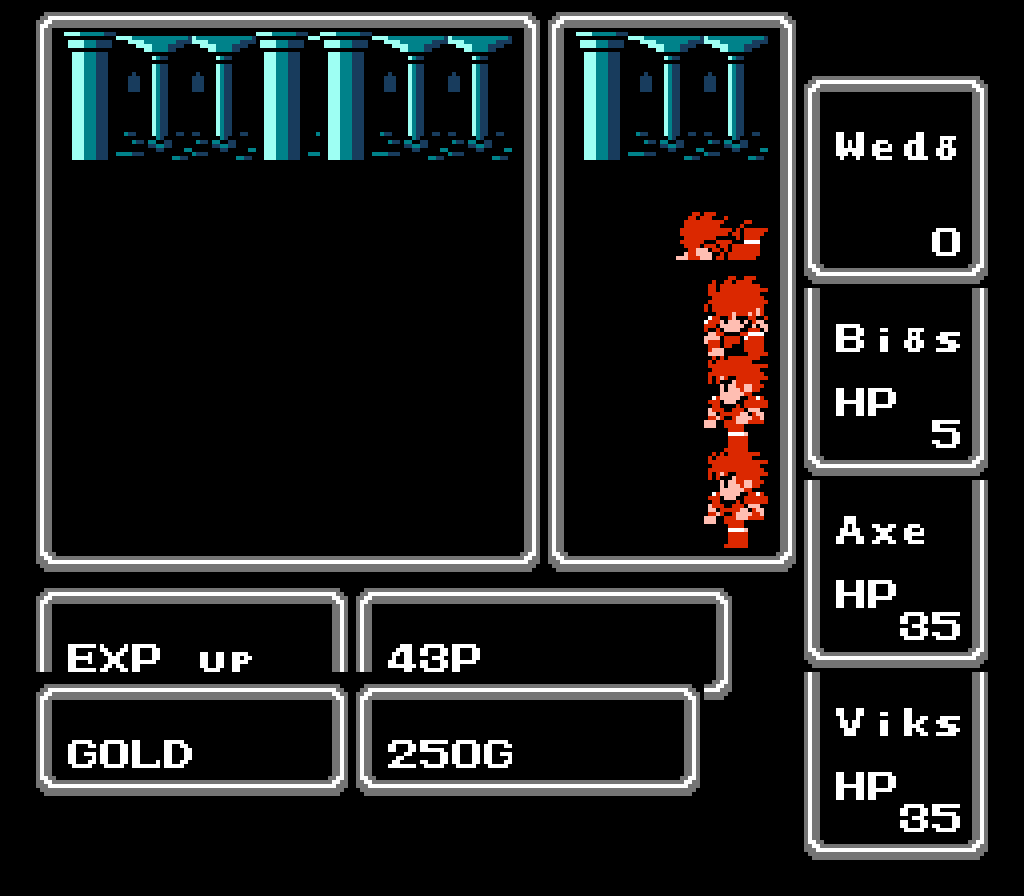
Final Fantasy and Final Fantasy II were famously hard on the NES and Famicom. Every remake since has made them easier — but not by weakening the monsters. We read the original and Game Boy Advance cartridges side by side, lined them up with the PlayStation, PSP and Pixel Remaster releases, and asked what "easier" actually means: cheaper levels, tougher bosses, an MP bar instead of spell charges, shops that sell revival — and how many fights it takes to be ready for each boss.
1Same monsters, same rewards — a sixth of the grind
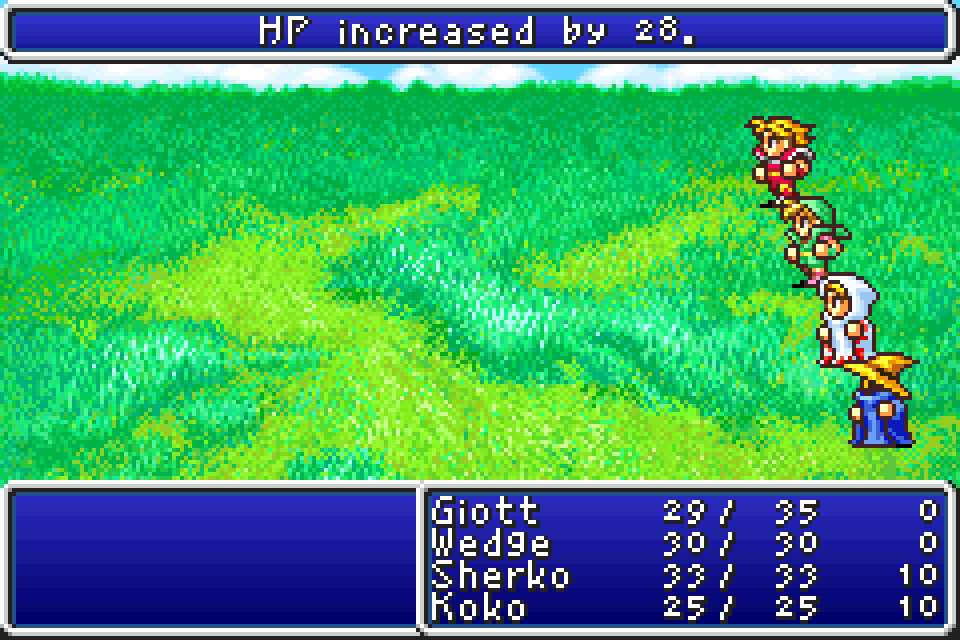
We read the Game Boy Advance cartridge side by side with the NES one. Every one of the 128 original monsters pays exactly the EXP and gil it paid in 1990. What changed is the price of a level: reaching level 20 takes 96,332 EXP on the NES and 16,226 on the Game Boy Advance — about a sixth. By level 50, the NES cap, it is 989,641 against 271,149, and the Game Boy Advance keeps going to 99.
Level 20 costs 96,332 EXP on the NES and 16,226 on the Game Boy Advance
Total EXP needed to reach each level (thousands), read from both cartridges
- NES (1990)
- Game Boy Advance (2004)
2The bosses got tougher on paper
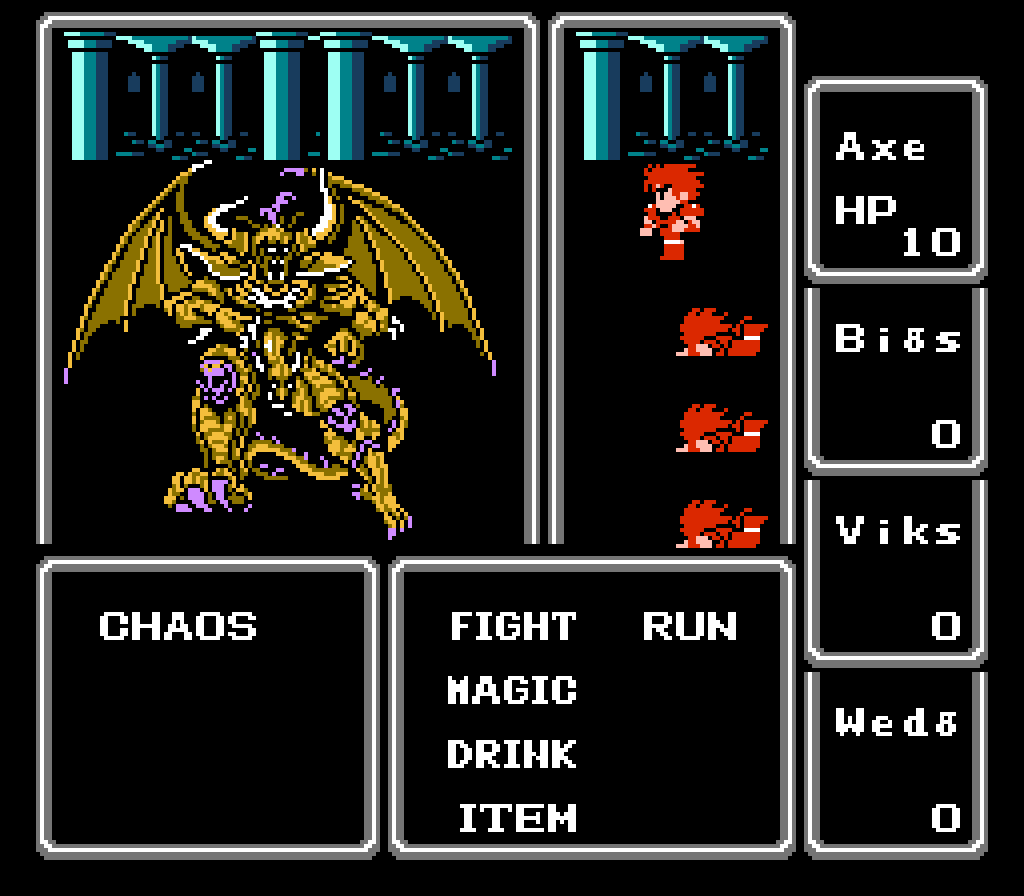
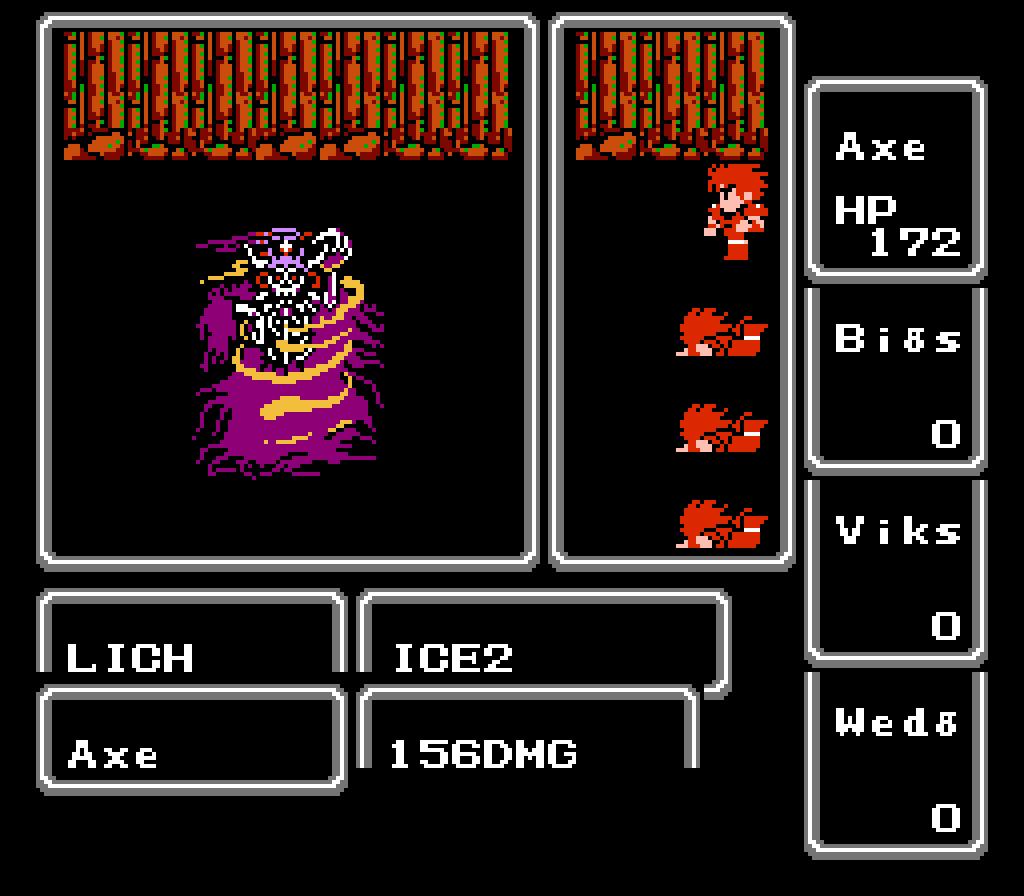
The remakes answered the faster levels by thickening the bosses. The Game Boy Advance doubled Garland (212 HP against 106), tripled Lich, and gave Chaos 20,000 HP where the NES gave 2,000. The 2003 PlayStation release had taken a gentler route: it left the early bosses alone and doubled the Fiends and Chaos. Only 14 monsters' HP changed at all — every one of them a boss or a boss-class fight.
Chaos went from 2,000 HP to 20,000; the PlayStation release doubled the bosses, the Game Boy Advance multiplied them
Boss HP in each version as a multiple of the NES (blank: no source for that version)
3Where the Pixel Remaster's numbers come from
The Pixel Remaster is sold as a return to the original. Its monster numbers say otherwise. On the 14 monsters the Game Boy Advance changed, the PSP and the Pixel Remaster carry the Game Boy Advance's HP (14 of 14 for the Pixel Remaster), not the NES's; the PlayStation release, a year older, has its own set. Final Fantasy II follows the same line: the Famicom's bosses, doubled or raised on the Game Boy Advance, carried into the PSP and Pixel Remaster.
The Pixel Remaster's monsters descend from the Game Boy Advance, not the NES
HP of the 14 monsters the Game Boy Advance changed, in each later version: which set it matches
- GBA numbers
- NES numbers
- Its own numbers
4When is the party ready — and how many fights does it take?
Levels only mean something against what they have to beat. For each boss we worked out, from each cartridge's own tables, the lowest level at which a standard party — Fighter, Black Belt, White Mage, Black Mage — beats it before its attacks, spells and breaths (read from the cartridge's enemy AI) wear the party down past 60% of its HP, counting the White Mage's healing; and how many fights of grinding reaching that level costs in the area before the boss.
The answer isn't "the bosses got easier". On the Game Boy Advance the party has to be a few levels higher for most Fiends — they have two to three times the HP — but a level costs a sixth of the EXP. Through Tiamat, the NES party needs 170 fights of grinding and the Game Boy Advance party 45. Chaos is the exception: with 20,000 HP he asks for a level-54 party on the Game Boy Advance, against level 24 on the NES.
Through Tiamat: 170 fights of grinding on the NES, 45 on the Game Boy Advance
Cumulative fights of grinding needed to be ready for each boss in turn (model; rules below)
- NES
- Game Boy Advance
The Game Boy Advance party must be a few levels higher for most Fiends — and far higher for Chaos
Level at which the model party is ready for each boss (one dot: both versions agree)
- NES
- Game Boy Advance
| NES | Game Boy Advance | |
|---|---|---|
| Ready at level | 8 | 14 |
| Fights of grinding | 20 | 21 |
| Party HP | 646 | 842 |
| Fighter | Silver[sword] (36.3/round) | Longsword (14.8/round) |
| Black Belt | unarmed (5.3/round) | unarmed (10.9/round) |
| Black Mage's spell (casts) | FIR2 ×3 | Firaga ×6 |
| White Mage's heal (casts) | HEAL ×3 | Healara ×5 |
| Boss's turn | 25% attack · 75% spell · 0% skill | 52% attack · 48% spell · 0% skill |
| Boss damage per turn | 102 | 112 |
| Rounds to win | 4 | 6 |
The model's rules, and how much the answer depends on them
- All four characters are the same level and alive. Stats are the starting stats plus the level-up table's expected gains (a flagged stat rises by 1; an unflagged one with the cartridge's chance — 1 in 4 on the NES, 1 in 7 on the Game Boy Advance, both read from the code).
- Equipment is the best each class can equip from the shops of the towns open by then and the chests of dungeons already cleared (NES shops and all chests: cartridge; Game Boy Advance shops: GBA-specific guides). The Black Belt fights unarmed when that hits harder.
- Physical damage per hit is rand(A..2A) − defense (minimum 1), A = weapon + Strength/2 (unarmed: 2 × level on the NES; Strength/2 + ¾ Vitality on the Game Boy Advance); hits = 1 + accuracy/32 (the Game Boy Advance adds Agility to accuracy). Checked in play: 102 of 102 logged NES hits and 95 of 95 logged Game Boy Advance attacks fell inside the predicted range, and all 547 logged Game Boy Advance party swings connected.
- The Black Mage casts his strongest damage spell and the White Mage her strongest heal while charges (NES) or MP (Game Boy Advance) last; weakness ×1.5, resistance ×0.5.
- Each boss turn is an attack, a spell or a skill with the odds in the cartridge's enemy AI table, cycling through its lists; enemy spell damage follows each cartridge's own routine (code-read, not yet checked in play).
- Ready = the boss falls within 20 rounds and its damage, net of healing, never passes 60% of the party's HP. Items (potions, Phoenix Downs, Ethers) are not used.
- Fights = EXP from the previous boss's ready level to this one's, earned in the area just before the boss (average EXP per battle from the cartridge's encounter tables and formations, split four ways).
- With other thresholds (10–30 rounds, 50–80% of HP) the totals move but the picture holds: through Tiamat, 164–178 fights on the NES against 40–45 on the Game Boy Advance; Chaos at level 23–25 on the NES against 51–91 on the Game Boy Advance.
5From spell charges to an MP bar
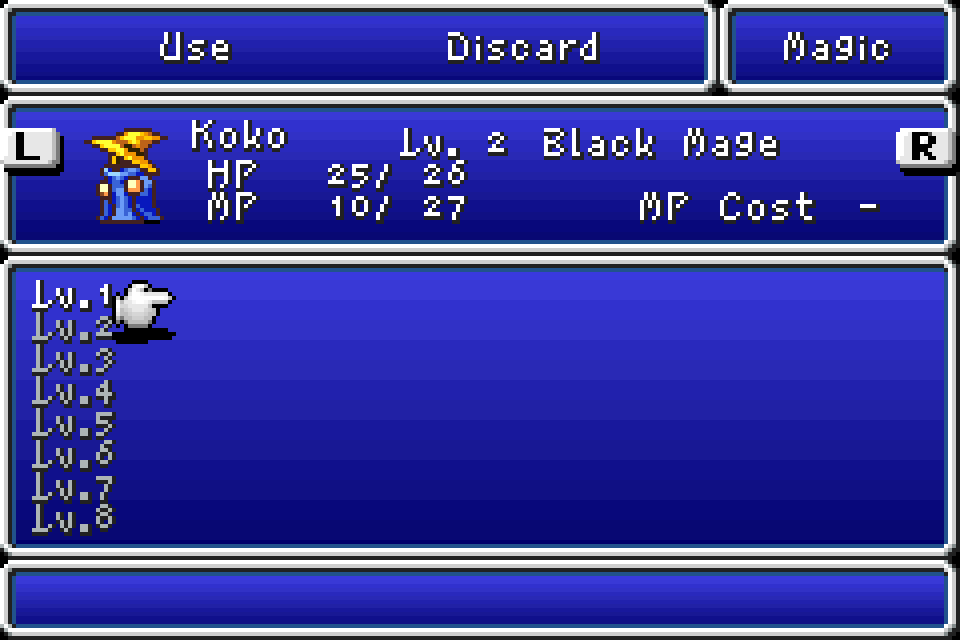
The NES gives each spell level its own handful of charges — a Black Mage at level 10 can cast 6 level-1 spells before resting, and never more than 9. The Game Boy Advance pools everything into MP. The same Black Mage at level 10 can cast Fire 26 times, and 86 times at level 30. On the NES several spells were broken (TMPR, SABR and LOCK did nothing; LOK2 helped the enemy); the PlayStation release fixed Temper and Saber, and the Game Boy Advance fixed the rest.
At level 10, a Black Mage casts 6 level-1 spells on the NES and 26 Fires on the Game Boy Advance
Level-1 black magic casts available before resting, by character level (expected MP growth from the Game Boy Advance cartridge)
- NES: level-1 spell charges
- Game Boy Advance: Fires per full MP bar
What the shops sell
| Town | NES item shop (gil) | Game Boy Advance item shop (gil) |
|---|---|---|
| Coneria / Cornelia | HEAL[potion] (60), PURE[potion] (75), TENT (75) | Potion (40), Antidote (50), Phoenix Down (500), Sleeping Bag (50) |
| Pravoka | HEAL[potion] (60), PURE[potion] (75), TENT (75), CABIN (250) | Potion (40), Ether (150), Antidote (50), Eye Drops (50), Phoenix Down (500) |
| Elfland / Elfheim | HEAL[potion] (60), PURE[potion] (75), CABIN (250), HOUSE (3000), SOFT[potion] (800) | Potion (40), Antidote (50), Gold Needle (500), Echo Grass (50), Tent (160) |
| Melmond | — | — |
| Crescent Lake | HEAL[potion] (60), PURE[potion] (75), CABIN (250), HOUSE (3000) | Potion (40), Hi-Potion (150), Ether (150), Phoenix Down (500), Tent (160) |
| Onrac | CABIN (250), HOUSE (3000), HEAL[potion] (60), PURE[potion] (75), SOFT[potion] (800) | Hi-Potion (150), Ether (150), Remedy (1500), Gold Needle (500), Cottage (2000) |
| Gaia | CABIN (250), HOUSE (3000), HEAL[potion] (60), PURE[potion] (75) | Hi-Potion (150), Ether (150), Phoenix Down (500), Tent (160), Cottage (2000) |
6Final Fantasy II stopped punishing you
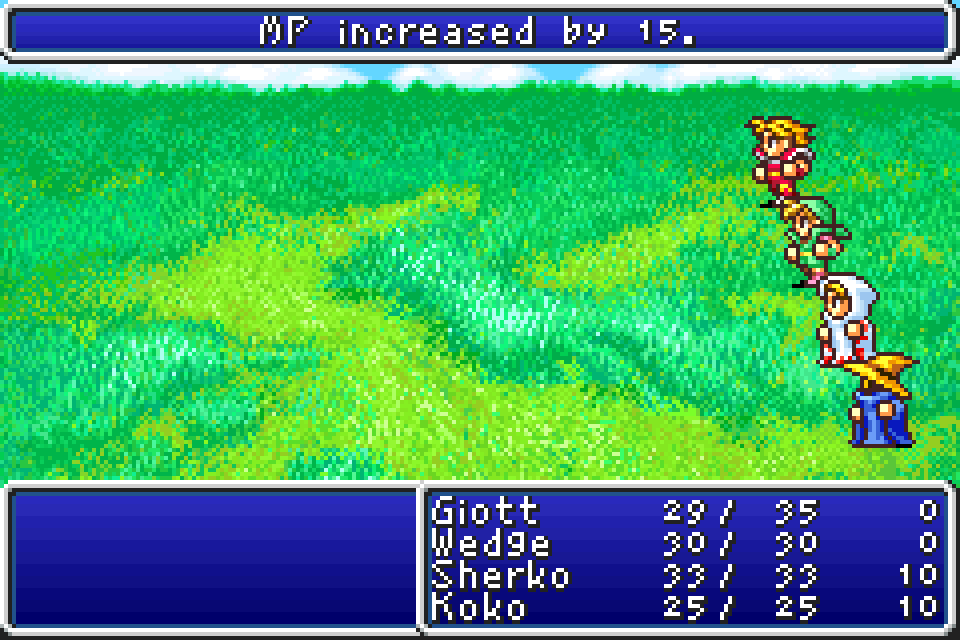
Final Fantasy II has no experience at all: characters grow by what they do in battle. Read from the cartridges, the Famicom version pairs each gain with a loss — Strength up can cost Intellect, Intellect up can cost Stamina — and a weapon or spell skill needs 100 points for every level. The Game Boy Advance removes the losses entirely (the roll still happens; nothing reads it), guarantees a Max HP gain after ten battles without one, adds 10 weapon-skill points after every battle, and front-loads the skill curve: 135 points for the first five levels instead of 500. It also pays half again as much gil per drop. And, as in Final Fantasy I, the Game Boy Advance raised a handful of bosses — Roundworm, Emperor (first), Behemoth, Emperor (final) — and the PSP and Pixel Remaster kept its numbers.
| Rule | Famicom (1988) | Game Boy Advance (2004) |
|---|---|---|
| Stat decreases | Strength↑ can cost Intellect, Intellect↑ Stamina, Spirit↑ Strength | None |
| Max HP gain | Only after losing HP in that battle | Same, plus a guaranteed gain after 10 battles without one |
| Weapon skill points per battle | attacks + rank − level | attacks + rank − level + 10 |
| Skill points per level | 100 at every level | 20, 25, 25, 30, 35, 40… up to 100 |
| Gil per drop | 1× | 1.5× |
Final Fantasy II's bosses: the Game Boy Advance raised a few, and the PSP and Pixel Remaster kept its numbers
Boss HP in each version as a multiple of the Famicom (blank: no source for that version)
Monster Explorer
Compare any Final Fantasy I or II monster across versions. ROM: read from that version's cartridge. REF: a source written for that version.
Chaos Final Fantasy · NES CHAOS
| HP | Attack | Defense | EXP | Gil | ||
|---|---|---|---|---|---|---|
| NES 1990 | 2,000 | 100 | 100 | 0 | 0 | ROM |
| PlayStation 2003 | 4,000 | 100 | 100 | 0 | 0 | REF |
| GBA 2004 | 20,000 | 170 | 100 | 0 | 0 | ROM |
| PSP 2007 | 20,000 | 170 | 100 | 0 | 0 | REF |
| Pixel Remaster 2021 | 20,000 | 170 | 100 | 0 | 0 | REF |
How we know
The NES and Famicom Final Fantasy, the Famicom Final Fantasy II and its unreleased US prototype, and the Game Boy Advance Dawn of Souls were read from our own dumps, in place and never modified: monster tables, formations and encounter tables, EXP tables, level-up and growth tables, starting stats, weapons, armor, shops and spell tables. Rules we read from the program code rather than saw in play are labeled "code-read". The PlayStation Origins, PSP and Pixel Remaster values come from sources written for each version — per-version bestiaries and guides — and are left out where only low-confidence or copied sources exist; a version with no source shows "—". No usable dumps of the PlayStation or WonderSwan Color releases were available, so those are reference-only (and the WonderSwan Color has no source for monster HP at all).