Report #6 · Dragon Warrior I–IV · NES, Famicom, Super Famicom, Game Boy Color
The Metal Slime Economy
Every Dragon Quest player learns to chase the silver blobs that run. Is it worth it? We read each cartridge's rules for who runs, who dodges and what a blow can do to defense 1,023, played 20,000 battles per case, and reran report #4's grind with the metals hunted and with them ignored — in fights, and in minutes at the speed each game really runs.
1What you're hunting
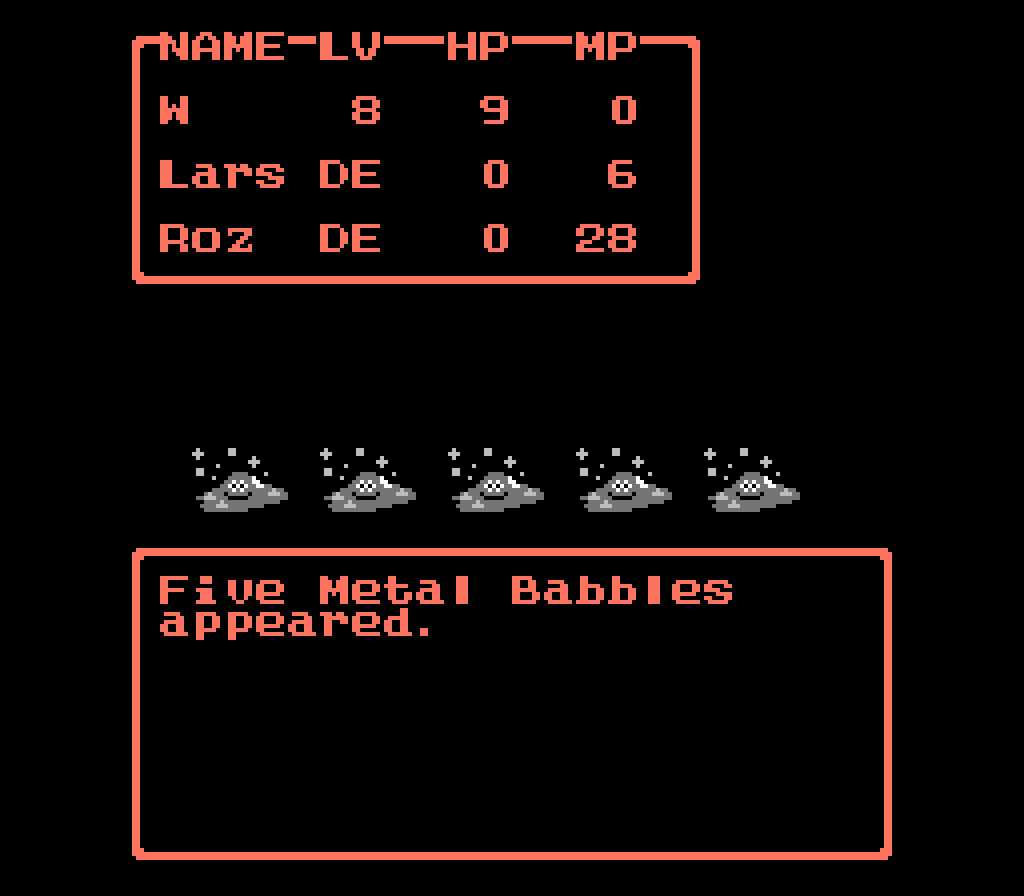
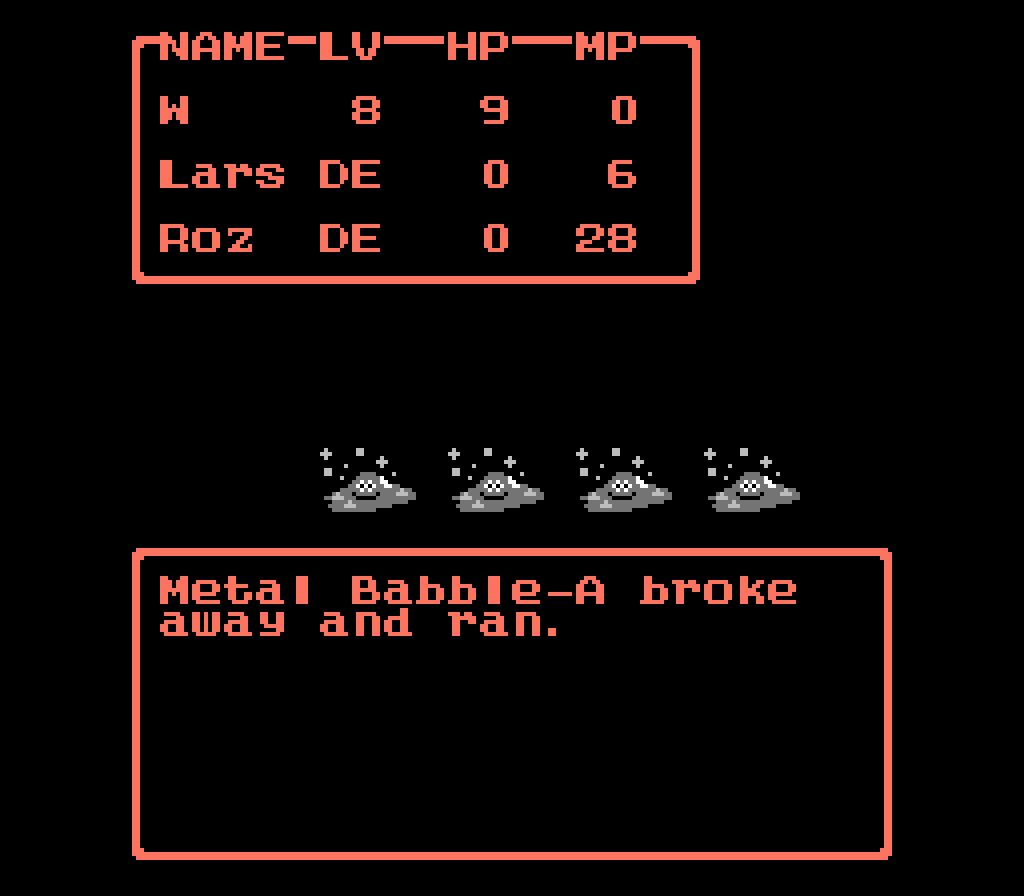
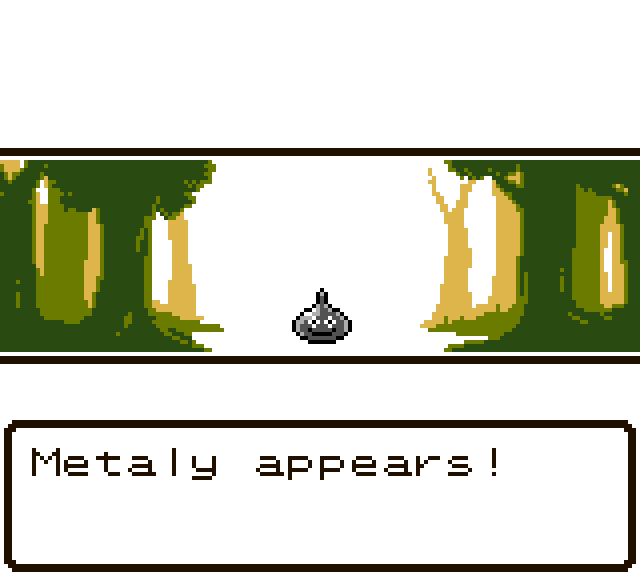
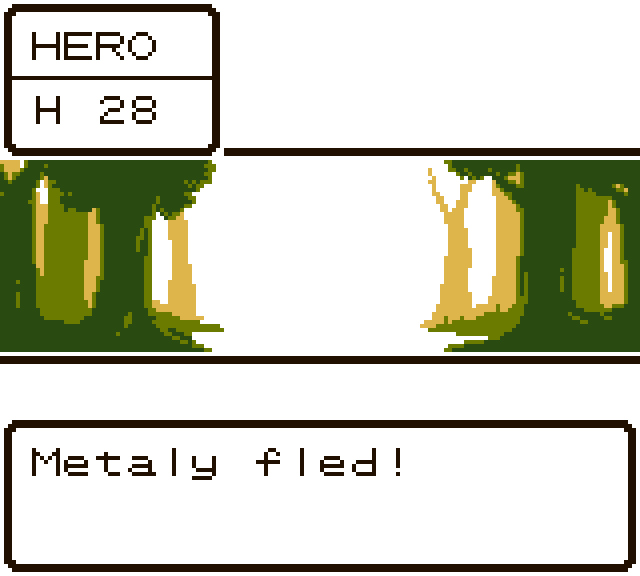
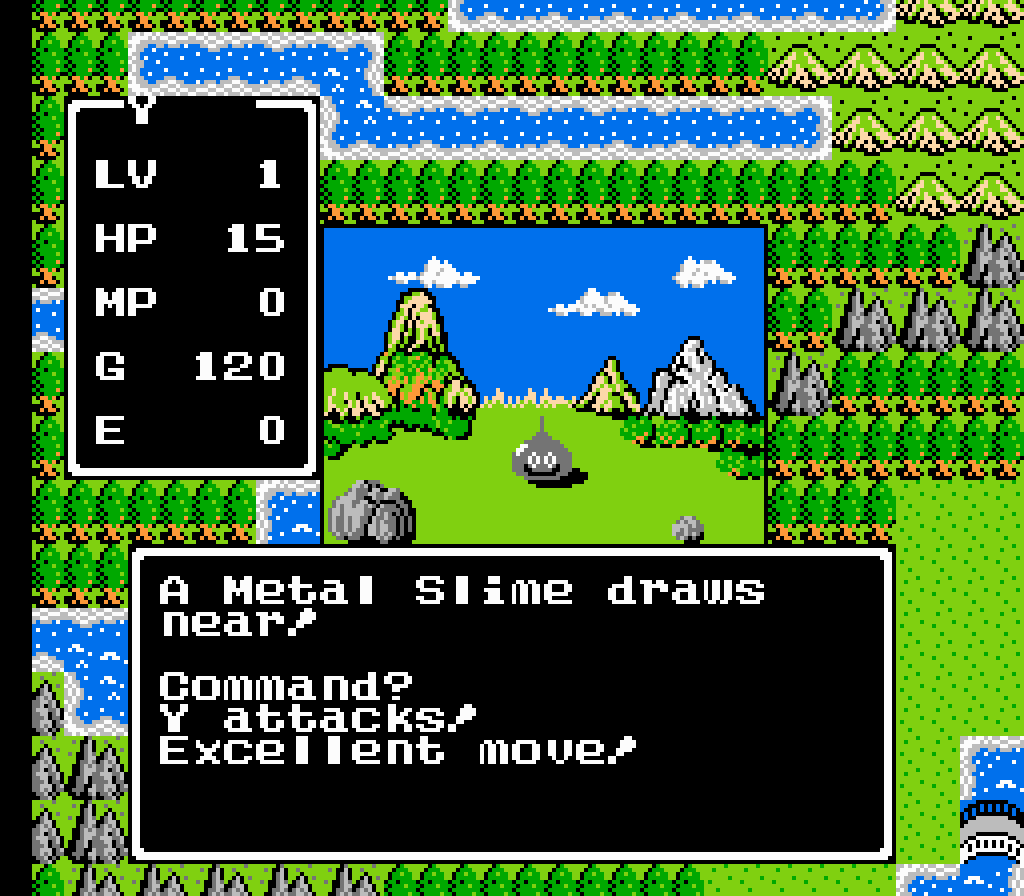
The metal family is built to be missed: a handful of HP behind a defense no ordinary blow can beat, and a habit of leaving. But "leaving" is a different rule in every cartridge. On the NES Dragon Warrior, a Metal Slime can only run once the hero is strong enough to scare it (Strength 20), then on a quarter of its turns. Everywhere else the metal decides when it acts: a share of its action slots say "run away", and when one comes up it always succeeds.
Most metals run on three to five of every eight actions — Dragon Warrior III's Metal Babble most of all
Chance that a metal's action is to run away, per cartridge (always successful when chosen; DW1 NES: once the hero's Strength is 20+)
- NES
- Game Boy Color
- Super Famicom
| Version | Metal | HP | Defense | Agility | EXP | Runs | Dodges | Source |
|---|---|---|---|---|---|---|---|---|
| NES · Metal Slime | Metal Slime | 3-4 | 1023 | 47 | 4,140 | 3/8 of its actions | 0 | ROMmetal_rules_dw3_dq3_us.csv (code-read) |
| NES · Metal Babble | Metal Babble | 5-6 | 1023 | 150 | 40,200 | 5/8 of its actions | 12/256 | ROMmetal_rules_dw3_dq3_us.csv (code-read) |
| Famicom · Metal Slime | Metal Slime | 3-4 | 1023 | 47 | 4,140 | 3/8 of its actions | 0 | ROMmetal_rules_dw3_dq3_jp.csv (code-read) |
| Famicom · Metal Babble | Metal Babble | 5-6 | 1023 | 150 | 40,200 | 5/8 of its actions | 12/256 | ROMmetal_rules_dw3_dq3_jp.csv (code-read) |
| SFC · Metal Slime | Metal Slime | 3-4 (80-100% of 4) | 1023 | 47 | 4,140 | 3/8 of its actions | 0 | ROMmetal_rules_dw3_dq3_sfc_jp.csv (code-read) |
| SFC · Metal Babble | Metal Babble | 4-6 (80-100% of 6) | 1023 | 150 | 40,200 | 5/8 of its actions | 11/256 | ROMmetal_rules_dw3_dq3_sfc_jp.csv (code-read) |
| SFC · Metal Chimaera | Metal Chimaera | 120-150 | 350 | 120 | 9,000 | never (no flee slot) | 22/256 | ROMmetal_rules_dw3_dq3_sfc_jp.csv (code-read) |
| GBC · Metal Slime (Metaly) | Metal Slime (Metaly) | 4 | 1023 | 47 | 4,140 | 3/8 of its actions | 0 | ROMmetal_rules_dw3_dw3_gbc_us.csv (code-read) |
| GBC · Metal Babble (Metabble) | Metal Babble (Metabble) | 6 | 1023 | 150 | 40,200 | 5/8 of its actions | 16/256 | ROMmetal_rules_dw3_dw3_gbc_us.csv (code-read) |
| HD-2D (2024) · Liquid Metal Slime | Liquid Metal Slime · はぐれメタル | 6 | 1536 | 636 | 49,848 | 63.7% (a source's count) | no source | REFDQ Wiki: https://dragon-quest.org/wiki/Liquid_metal_slime (accessed 2026-09-27) · sources disagree on HP: 25 / 6 · on running: Measured 255 flees in 400 turns = 63.7% while defending (crs-10 blog, 2025-01-13) |
| HD-2D (2024) · Metal Chimaera | Metal Chimaera · メタルキメラ | 240 | 861 | 281 | 7,602 | no source | no source | REFDQ Wiki: https://dragon-quest.org/wiki/Metal_chimaera (accessed 2026-09-27) · sources disagree on EXP: 20000 / 7602 |
| HD-2D (2024) · Metal Slime | Metal Slime · メタルスライム | 4 | 1536 | 316 | 4,140 | no source | no source | REFDQ Wiki: https://dragon-quest.org/wiki/Metal_slime (accessed 2026-09-27) · sources disagree on HP: 30 / 4 |
| HD-2D (2024) · Hardy Hand | Hardy Hand · メタルハンド | 320 | 901 | 255 | 3,200 | no source | no source | REFDQ Wiki: https://dragon-quest.org/wiki/Hardy_hand (accessed 2026-09-27) · sources disagree on EXP: 12000 / 3200 |
| Mobile (2014) · Liquid Metal Slime | Liquid Metal Slime · はぐれメタル | 6 | 1023 | 150 | 40,200 | runs often (no rate given) | no source | REFcour89: https://cour89.com/dq3/monsters/074.php (accessed 2026-09-27) · on running: "メタルスライムよりも逃げる確率が高く" (flees more often than Metal Slime); no rate |
| Mobile (2014) · Metal Chimaera | Metal Chimaera · メタルキメラ | 150 | 350 | 120 | 9,000 | no source | no source | REFcour89: https://cour89.com/dq3/monsters/128.php (accessed 2026-09-27) · sources disagree on EXP: 900 / 9000 |
| Mobile (2014) · Metal Slime | Metal Slime · メタルスライム | 4 | 1023 | 47 | 4,140 | runs often (no rate given) | no source | REFcour89: https://cour89.com/dq3/monsters/058.php (accessed 2026-09-27) · on running: "高確率で逃げます" but "メタル系にしては逃げる確率は低め" (lower than other metals); no rate |
| Switch (2019) · Liquid Metal Slime | Liquid Metal Slime · はぐれメタル | 6 | — | — | 40,200 | no source | no source | REFRoD: https://www.realmofdarkness.net/dq/switch-dq3-monsters/ (accessed 2026-09-27) |
| Switch (2019) · Metal Chimaera | Metal Chimaera · メタルキメラ | 150 | — | — | 900 | no source | no source | REFRoD: https://www.realmofdarkness.net/dq/switch-dq3-monsters/ (accessed 2026-09-27) · only a low-confidence source (900 is likely a typo for 9,000) |
| Switch (2019) · Metal Slime | Metal Slime · メタルスライム | 4 | — | — | 4,140 | no source | no source | REFRoD: https://www.realmofdarkness.net/dq/switch-dq3-monsters/ (accessed 2026-09-27) |
ROM: read from that version's cartridge (the DS row from our dump of the European cart, tables only, not seen in play). REF: a source written for that release; its source and any disagreement between sources show when you hover the badge (on a phone, under it). "no source": nothing written for that release says.
2Kill odds per encounter
A metal pays only if it falls before it leaves. We played each cartridge's battle rules — who acts first each round, the dodge, the critical hit that ignores defense, the 0-or-1 damage of an ordinary blow, and each metal-killing tool the cart offers — through 20,000 seeded battles per case, with the party the grind model has at the point where metals start to pay (or at the end of the game, where they never do). The party attacks the metals every turn.
On the NES Dragon Warrior III, a lone Metal Babble falls in 8% of battles to ordinary weapon blows; with Poison Needle (Wizard) it is 14%. The Poison Needle's trick is that it never misses: every blow does exactly 1 damage, and one in eight kills outright.
Dragon Warrior IV's metal-killers double or triple the odds; the older carts' tools add half at most
Chance that one metal falls before it runs: ordinary weapon blows, and the best tool the cart offers (same party)
- Best tool the cart offers
- Ordinary weapon blows
Dragon Warrior III (NES): bigger groups of Metal Babbles mean at least one usually falls — but each is safer
Chance at least one Metal Babble falls, by tool; each tool's bars are groups of 1, 2, 3 and 4 (party at level 14)
3EXP per real minute
Kill odds become EXP per minute once they meet the formation tables and the clock. At every step of report #4's grind we priced the best open, safe zone twice for the same party: with the metals paying what the kill-odds model says, and with the metals ignored. Each battle costs the cart's measured seconds (battle plus walking to the next one, from report #4's input-only runs). The break-even is the first level where the metals make the best zone at least 10% richer.
Where metals pay most, they add a few percent in DW1 and on the NES DW2 — and multiply EXP per minute two to four times in DW2 GBC, DW3 and DW4
EXP per party member per real minute at the level where metals add the most: without metals, and with them
- With the metals (kill-odds model)
- Metals ignored
Dragon Warrior III (NES): metals start to pay at level 14
EXP per party member per real minute in the best open, safe zone, by the lead's level: with the metals, and with them ignored
- With the metals
- Metals ignored
4Hours saved on the Grind Tax path
Report #4 asked how many fights a party needs to be ready for every boss. We reran that model twice per cartridge: once with the metals hunted with everything the cart offers (the Poison Needle and HURT where they exist, swapped in for grinding), and once with the metals ignored. The difference is what the metal family is worth on the critical path. On the Game Boy Color Dragon Warrior II it is 243 fights — a third of the game's grind. On the NES Dragon Warrior it is 10. On the NES Dragon Warrior III, 77.
Metals save 243 fights on the Game Boy Color Dragon Warrior II — and almost nothing on the NES Dragon Warrior
Fights from a new game to the last boss with the metals ignored, minus the fights when they are hunted (model)
- NES
- Famicom
- Game Boy Color
- Super Famicom
5Report #4, corrected
Report #4 priced runners with a shortcut: the k-th metal of a battle falls after k × r rounds (r = its HP over the party's average damage), so it pays with chance (1 − q)k·r. It used the average number of metals per battle, over every battle in the zone. The kill-odds model plays the battle instead, with the group sizes the formation tables actually produce — and the remakes' metals come in groups of up to eight, where a four-member party cannot reach most of them before they run. So report #4 was generous: every cart needs more fights than it said, most of all DW3 GBC (422 → 645). The rankings in report #4 hold; the totals move.
Report #4 overpaid the metals: DW3 GBC needs 223 more fights than it said
Fights from a new game to the last boss: report #4's runner shortcut against the kill-odds model (ordinary weapons, same party and rules)
- Kill-odds model (report #6)
- Report #4 as published
6Dragon Warrior IV: the family grows a king
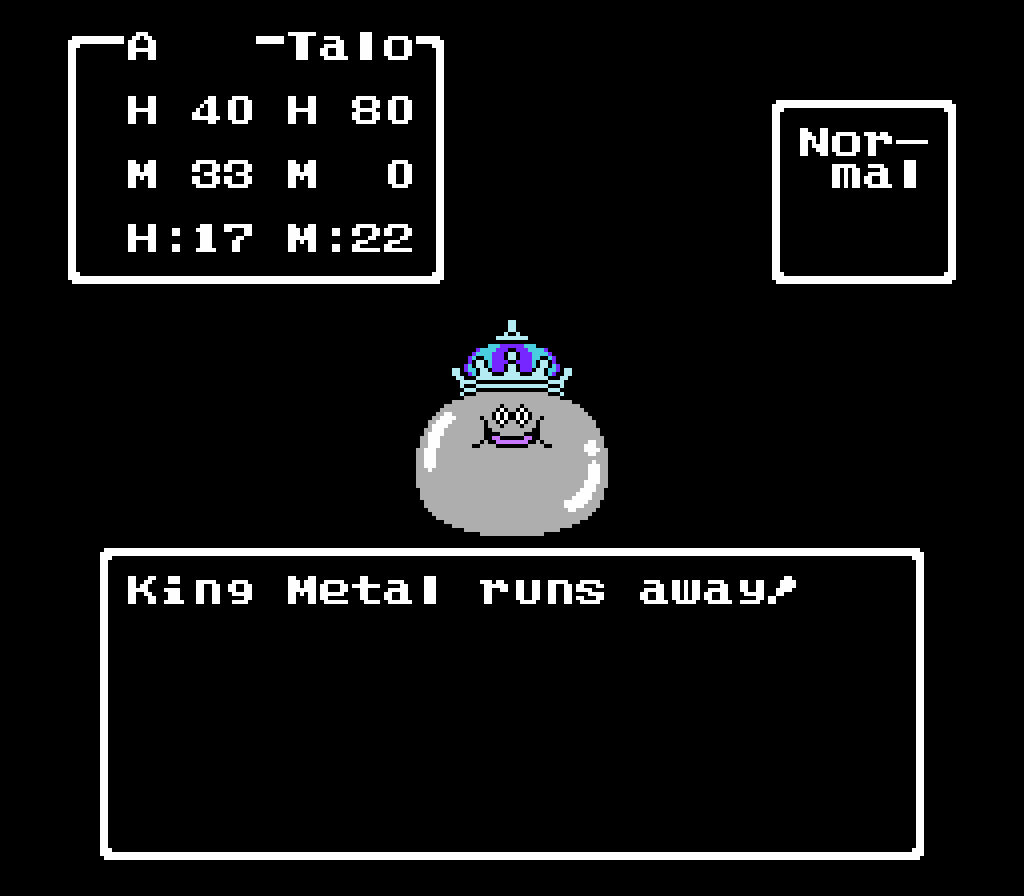
Report #4 stopped at Dragon Warrior III, so Dragon Warrior IV gets its own readiness model here, built the same way from both carts: the chapter parties (Ragnar, Alena's trio, Nara and Mara, then the Hero), the cart's shops and chests, its encounter zones, 28 boss fights with their decoded moves, and the guests who fight beside you (Healie, Orin, Hector). DW4 pays every living member the whole EXP of a battle, and adds a King Metal worth 30,010 EXP.
The cart hands out metal-killers: the Poison Needle (Mara and Brey) kills on 1 blow in 8 before the dodge roll; the Demon Hammer turns a third of its swings into criticals; the Metal Babble Sword always does exactly 2 to a metal. And Alena's critical chance is her level out of 256 — 16% at level 40. With the party at level 12, a lone Metal Slime falls in 16% of battles to ordinary blows.
| Boss | Ch. | NES level | NES fights, metals hunted | NES fights, metals ignored | Famicom fights, hunted |
|---|---|---|---|---|---|
| Saro's Shadow + Giant Eyeball | 1 | 9 | 38 | 38 | 38 |
| Chameleon Humanoid + 2 Rabidhounds | 2 | 4 | 13 | 13 | 13 |
| Hun (Endor tournament, Alena alone) | 2 | 13 | 66 | 70 | 67 |
| Roric (tournament) | 2 | 15 | 29 | 18 | 29 |
| Vivian (tournament) | 2 | 15 | 0 | 0 | 0 |
| Sampson (tournament) | 2 | 17 | 45 | 85 | 45 |
| Linguar (tournament) | 2 | 17 | 0 | 0 | 0 |
| Balzack (chapter 4) | 4 | 17 | 263 | 263 | 263 |
| 2 Liclicks (Hero alone) | 5 | 4 | 2 | 3 | 2 |
| 2 Tricksy Urchins + 2 Vampire Bats (Hero alone) | 5 | 5 | 2 | 2 | 1 |
| Lighthouse Bengal + 2 Flamers | 5 | 7 | 0 | 0 | 0 |
| Keeleon | 5 | 10 | 0 | 0 | 0 |
| Balzack | 5 | 13 | 4 | 4 | 4 |
| Bakor | 5 | 14 | 0 | 0 | 0 |
| Saroknight | 5 | 16 | 0 | 0 | 0 |
| Radimvice + 3 Demighouls | 5 | 32 | 66 | 122 | 66 |
| 3 Anderougs | 5 | 33 | 0 | 0 | 0 |
| Gigademon | 5 | 33 | 0 | 0 | 0 |
| Infurnus Shadow | 5 | 33 | 0 | 0 | 0 |
| Necrosaro (stage 1) | 5 | 33 | 0 | 0 | 0 |
| Necrosaro (stage 2) | 5 | 33 | 0 | 0 | 0 |
| Necrosaro (stage 3) | 5 | 33 | 0 | 0 | 0 |
| Necrosaro (stage 4) | 5 | 33 | 0 | 0 | 0 |
| Necrosaro (stage 5) | 5 | 33 | 0 | 0 | 0 |
| Necrosaro (stage 6) | 5 | 33 | 0 | 0 | 0 |
| Necrosaro (stage 7) | 5 | 35 | 15 | 24 | 15 |

Totals: NES 543 fights with the metals hunted, 642 with them ignored; Famicom 543 and 642. The model plays the chapter-5 party as Hero with Nara and Mara until Mintos, then Hero, Alena, Cristo and Mara; the NES lets the Hero alone take orders, and the model plays the others as if the player chose for them.
7Checked in play
We ran the carts in emulators, driven only by button input. On the NES that meant the public TASes and our own presses branched from their save states. On the Game Boy Color and Super Famicom there is no TAS, so we wrote bots that play from power-on. Every run read RAM each frame to log each metal's actions and each blow; nothing was written to memory, no ROM was patched, and every batch we report replayed byte for byte. Of the 17 metal checks that can be tested, 14 land inside their 95% interval.
| Cart | Monster | Check | Seen | Rate (95% interval) | Cart rule | Verdict | |
|---|---|---|---|---|---|---|---|
| DW1 NES · runs, hero Strength 20+ (per check) | Metal Slime | runs, hero Strength 20+ (per check) | 28 / 120 | 23.3% (16.7%–31.7%) | 1/4 | fits | TAS 4050M + our presses · 116 independent draws |
| DW1 NES · runs, hero Strength 19 | Metal Slime | runs, hero Strength 19 | 0 / 41 | 0.0% (0.0%–8.6%) | never (Strength/2 < its attack 10) | fits | TAS 4050M + our presses |
| DW1 NES · 1 damage per ordinary blow | Metal Slime | 1 damage per ordinary blow | 41 / 81 | 50.6% (40.0%–61.2%) | 1/2 | fits | TAS 4050M + our presses |
| DW1 NES · dodges per blow | Metal Slime | dodges per blow | 0 / 83 | 0.0% (0.0%–4.4%) | 1/64 | fits | TAS 4050M + our presses |
| DW2 NES · runs per decision | Metal Babble | runs per decision | 18 / 58 | 31.0% (20.6%–43.8%) | 4/8 | no test | TAS 4296M + our presses · not independent: every branch is wiped within a round or two, so most decisions repeat the shared first round |
| DW3 NES · runs per decision | Metal Babble | runs per decision | 52 / 67 | 77.6% (66.3%–85.9%) | 5/8 | traced | TAS 3093M + our presses · not independent (about 20 draws); traced instead: exactly 62.5% over all 2^24 generator states |
| DW4 NES · runs per action | King Metal | runs per action | 285 / 585 | 48.7% (44.7%–52.8%) | 128/255 | fits | TAS 5288M + our presses |
| DW4 NES · two actions in a round | King Metal | two actions in a round | 101 / 204 | 49.5% (42.7%–56.3%) | 1/2 | fits | TAS 5288M + our presses |
| DW4 NES · runs per action | Metal Babble | runs per action | 1,403 / 2,839 | 49.4% (47.6%–51.3%) | 127/255 | fits | TAS 5288M + our presses |
| DW4 NES · blows eluded | King Metal | blows eluded | 6 / 137 | 4.4% (2.0%–9.2%) | 16/256 | fits | TAS 5288M + our presses |
| DW4 NES · 1 damage per non-critical hit | King Metal | 1 damage per non-critical hit | 39 / 128 | 30.5% (23.2%–38.9%) | 85/256 | fits | TAS 5288M + our presses |
| DW4 NES · blows eluded | Metal Babble | blows eluded | 39 / 607 | 6.4% (4.7%–8.7%) | 12/256 | edge | TAS 5288M + our presses |
| DW4 NES · 1 damage per non-critical hit | Metal Babble | 1 damage per non-critical hit | 209 / 554 | 37.7% (33.8%–41.8%) | 85/256 | edge | TAS 5288M + our presses |
| DW4 NES · starts at 6 HP (else 7) | King Metal | starts at 6 HP (else 7) | 149 / 296 | 50.3% (44.7%–56.0%) | HP minus 0..HP/4: 1/2 | fits | TAS 5288M + our presses |
| DW1 GBC · runs per action | Metaly | runs per action | 83 / 216 | 38.4% (32.2%–45.1%) | 3/8 | fits | scripted from power-on |
| DW1 GBC · criticals per blow | Metaly | criticals per blow | 3 / 130 | 2.3% (0.8%–6.6%) | 1/32 (never dodged) | fits | scripted from power-on |
| DW1 GBC · 1 damage per ordinary blow | Metaly | 1 damage per ordinary blow | 72 / 127 | 56.7% (48.0%–65.0%) | 1/2 | fits | scripted from power-on |
| DW1 GBC · dodges per blow | Metaly | dodges per blow | 0 / 130 | 0.0% (0.0%–2.9%) | never | fits | scripted from power-on |
| DW1 GBC · starts at 3 HP (else 2) | Metaly | starts at 3 HP (else 2) | 96 / 96 | 100.0% (96.2%–100.0%) | 7/8 (table $34:4EA2) | disagrees | scripted from power-on · the random index only ever landed on table entries 0-3, for every low-HP monster; the model uses 3 HP |
| DW3 GBC · party strikes first | ordinary monsters | party strikes first | 13 / 460 | 2.8% (1.7%–4.8%) | 8/256 | fits | scripted from power-on |
| DW3 GBC · monsters strike first | ordinary monsters | monsters strike first | 9 / 460 | 2.0% (1.0%–3.7%) | 248/256 x 8/256 | fits | scripted from power-on |
| DW3 GBC · criticals per damaging hit | ordinary monsters | criticals per damaging hit | 44 / 2,589 | 1.7% (1.3%–2.3%) | 4/256 | fits | scripted from power-on |
| DW3 GBC · start HP equals the table | ordinary monsters | start HP equals the table | 1,603 / 1,603 | 100.0% (99.8%–100.0%) | always (no randomisation) | fits | scripted from power-on |
| DQ3 SFC · criticals per connecting hit | ordinary monsters | criticals per connecting hit | 23 / 1,456 | 1.6% (1.1%–2.4%) | 1/64 | fits | scripted from power-on |
| DQ3 SFC · 1 damage in the metals' 0-or-1 branch | ordinary monsters | 1 damage in the metals' 0-or-1 branch | 18 / 37 | 48.6% (33.5%–64.1%) | 1/2 | fits | scripted from power-on |
| DQ3 SFC · dodges, evasion code 1 | ordinary monsters | dodges, evasion code 1 | 10 / 586 | 1.7% (0.9%–3.1%) | 6/256 | fits | scripted from power-on |
| DQ3 SFC · slime flees while lead level <= its level + 5 | ordinary monsters | slime flees while lead level <= its level + 5 | 0 / 275 | 0.0% (0.0%–1.4%) | never | fits | scripted from power-on · the gate binds smart monsters only; metals (intelligence 0) have none |
| DQ3 SFC · slime flees once the gate opens | ordinary monsters | slime flees once the gate opens | 71 / 216 | 32.9% (27.0%–39.4%) | 76/256 | fits | scripted from power-on |
| DQ3 SFC · start HP within 80-100% of the table | ordinary monsters | start HP within 80-100% of the table | 1,089 / 1,089 | 100.0% (99.7%–100.0%) | 80-100% ($C90B75) | fits | scripted from power-on · the model now starts metals at 3-4 and 4-6 HP |
Hover a row (on a phone, read its last line) for how it was run and any note. "Ordinary monsters" rows check the code metals share with every monster, on carts where our bots did not reach a metal zone.
What the runs taught us
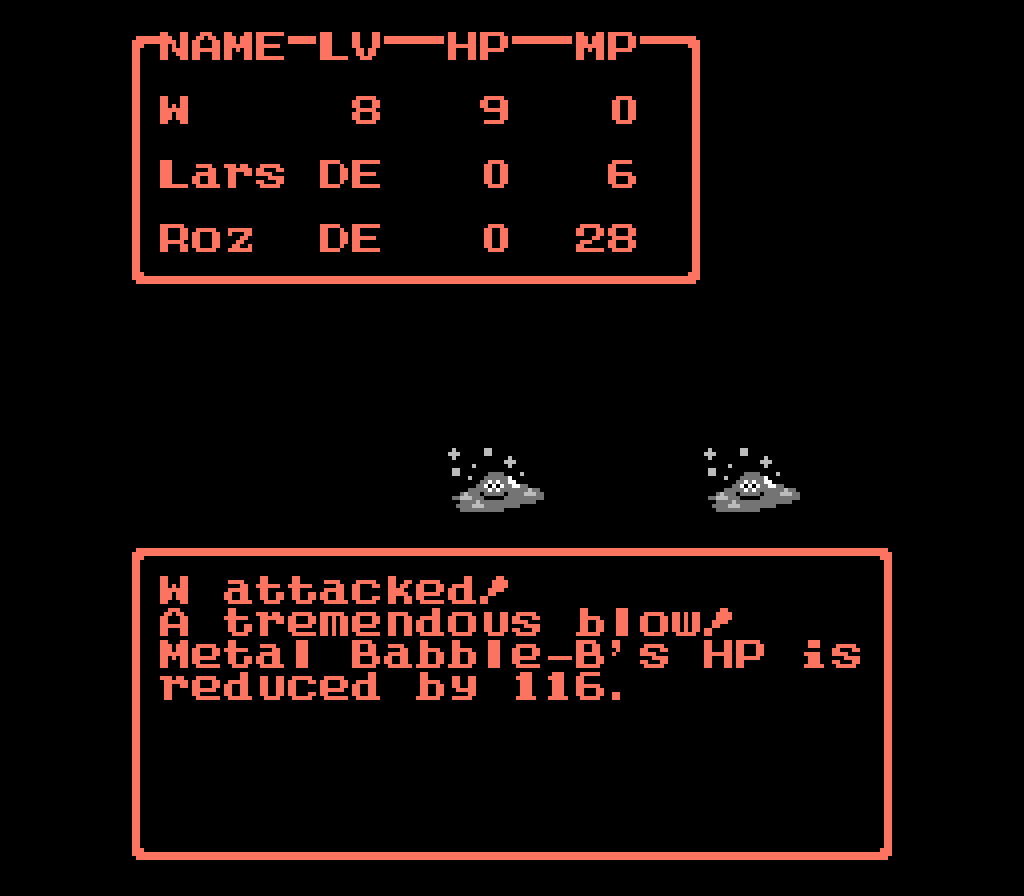
- Dragon Warrior (NES) runs only from the strong. With the hero at Strength 19, the Metal Slime never ran (0 of 41 checks); at Strength 22 it ran on 28 of 120, against the cart's 1 in 4. A trap for bots, and maybe for players: the cart starts a step only every 16 frames, so a hero who walks at a steady pace reads the random number at a fixed stride — on our run's stride, a Metal Slime never came up in 53 battles until the bot varied its pauses.
- Dragon Warrior III's Metal Babble runs on exactly 5 of 8 actions. Dragon Warrior III's Metal Babbles ran on about 78% of their logged turns against a 5-in-8 rule. We traced it: the cart picks a slot from the top three bits of its random number, and over all 2^24 states of its generator that is exactly 62.5% (37.5% for the Metal Slime). Our branches reused a handful of the same random draws — about 20 independent draws behind the logged turns — and those happened to say "run". The rule stands; the log was a small sample.
- Dragon Warrior IV's King Metal behaves as coded: it chose to run on 49% of its actions (rule 50.2%) and acted twice in 50% of rounds. Its HP started at 6 or 7 — the cart randomises it, which the model had missed, and now includes. On the Metal Babble two blow rates sit about two standard errors off the rule (dodges 6.4% against 4.7%, 1-damage hits 37.7% against 33.2%); we report that as it is.
- The Game Boy Color Metaly always starts at 3 HP. The cart's start-HP table gives a 4-HP monster 2 HP on one entry in eight, but in 96 battles the random index only ever landed on the first four entries — for every low-HP monster, not just the Metaly. The model uses what the cart does in play: 3 HP, and 4 for Dragon Warrior II's metals by the same routine.
- The long remakes kept their metals out of reach. Our Dragon Warrior III (GBC) bot played 460 battles from power-on and reached the Tempt Cave; the Super Famicom bot played 303 and reached Reeve. Their first metal zones lie many story steps further (the Super Famicom's need the ship). What they could test — critical hits, first-round odds, turn order, HP at the start of a battle, the 0-or-1 branch every blow on a metal takes — fits the code. The Super Famicom starts every monster at 80–100% of its HP, which the model now uses for its metals too; its ordinary slimes may only run once the party outlevels them by six, a gate the metals don't have. Their metal run rates stay code-read, and the runs keep their resume points.
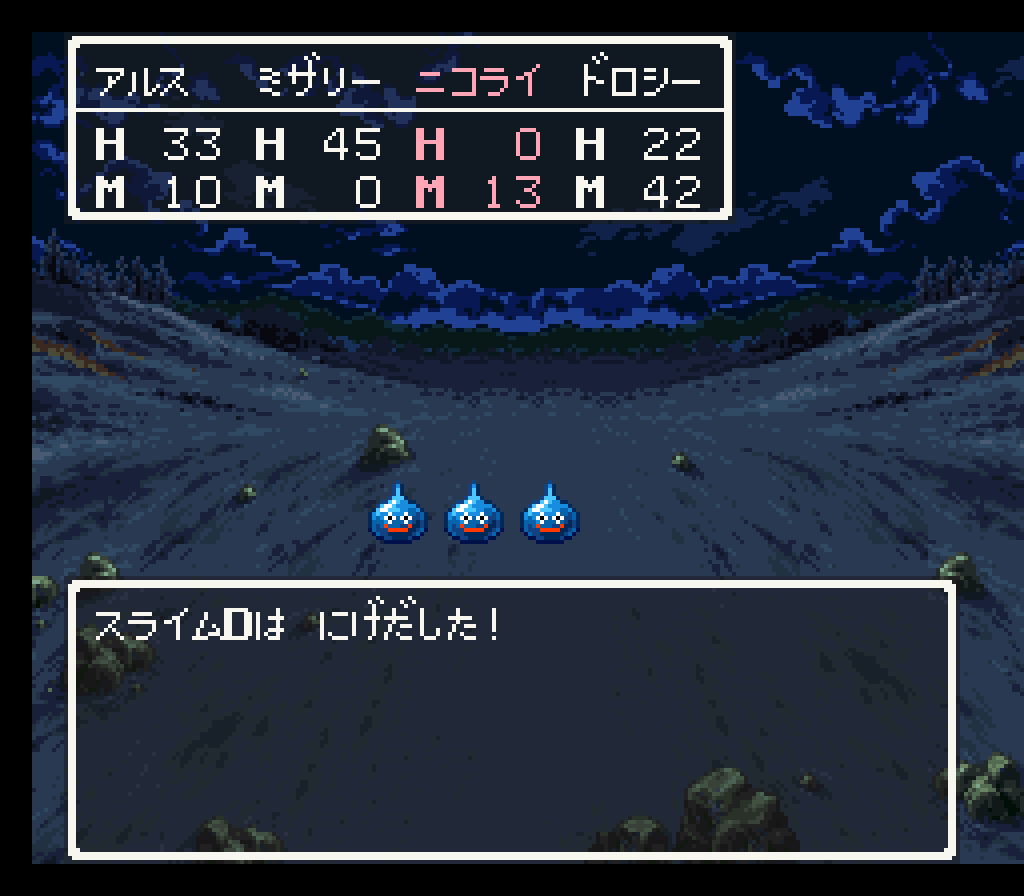
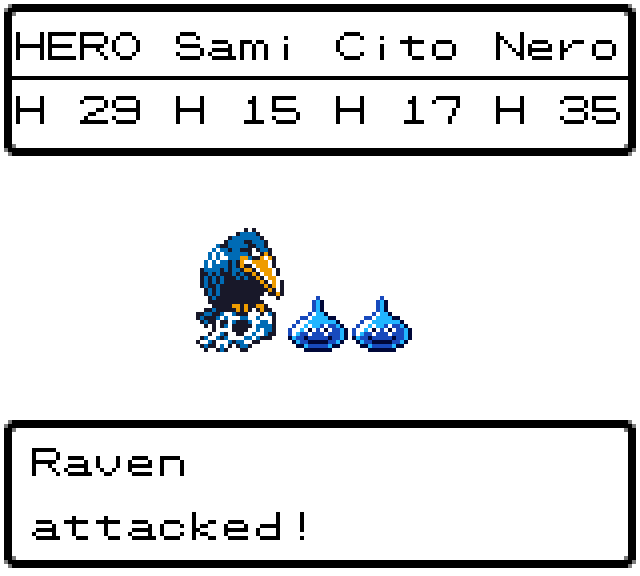
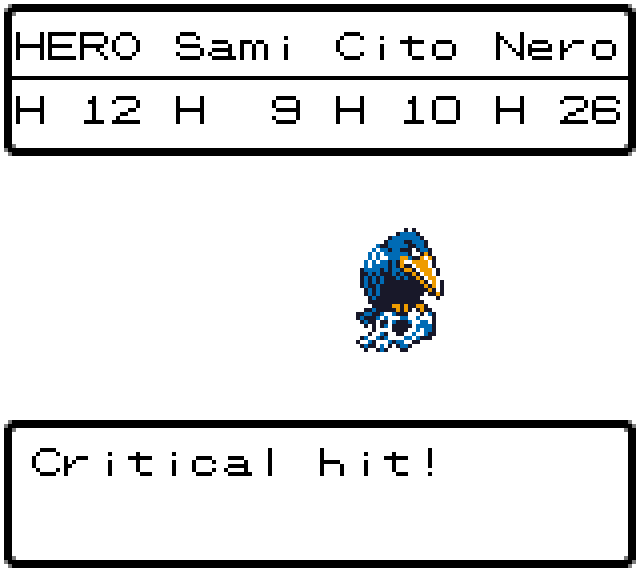
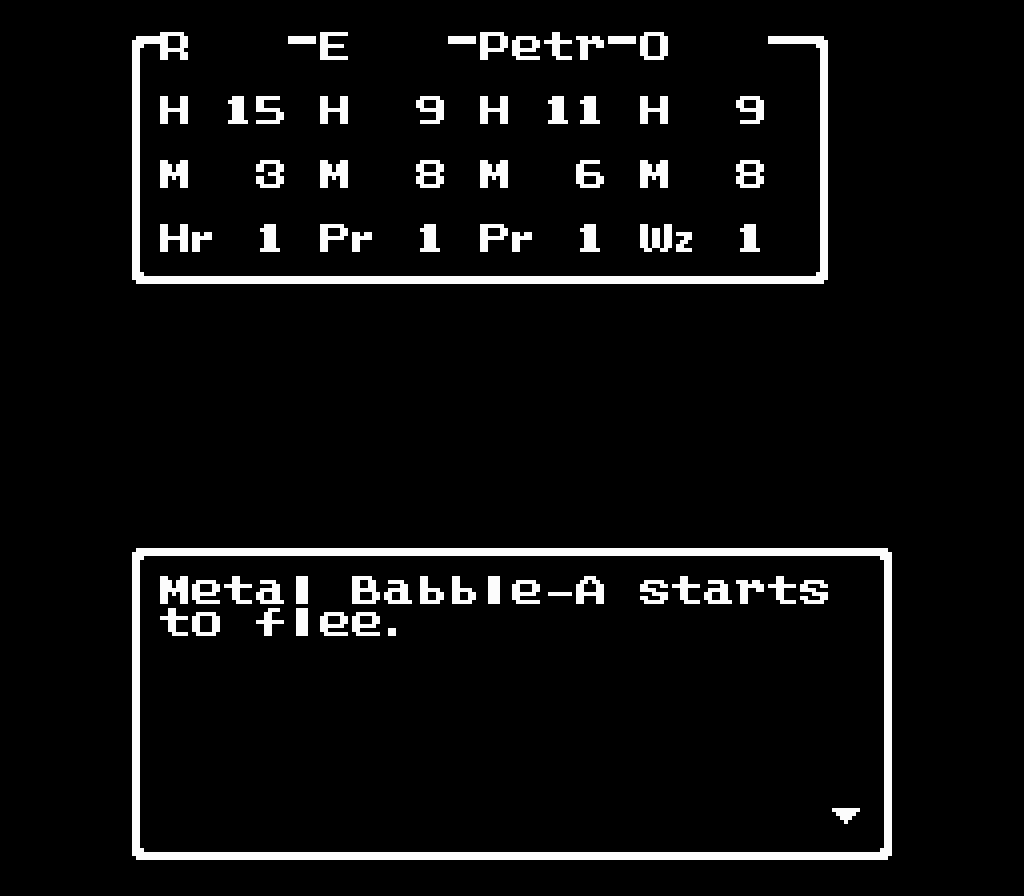
Metal Explorer
Any metal in this report, across versions and names. ROM: read from that version's cartridge. REF: a source written for that release.
Metal Babble
| Version | Name | HP | EXP | Runs | Falls alone* | Source |
|---|---|---|---|---|---|---|
| DW2 NES · Metal Babble | Metal Babble | 28-35 | 1,050 | 4/8 of its actions | 59% (level 29) | ROMmetal_rules_dw2_dq2_us.csv (code-read) |
| DW2 Famicom · Metal Babble | Metal Babble | 28-35 | 1,050 | 4/8 of its actions | 59% (level 29) | ROMmetal_rules_dw2_dq2_jp.csv (code-read) |
| DW2 GBC · Metal Babble (Metabble) | Metal Babble (Metabble) | 4 (same routine; table 4 or 3) | 10,150 | 4/8 of its actions | 19% (level 8) | ROMmetal_rules_dw2_dw12_gbc_us.csv (code-read) |
| DW3 NES · Metal Babble | Metal Babble | 5-6 | 40,200 | 5/8 of its actions | 8% (level 14) | ROMmetal_rules_dw3_dq3_us.csv (code-read) |
| DW3 Famicom · Metal Babble | Metal Babble | 5-6 | 40,200 | 5/8 of its actions | 8% (level 13) | ROMmetal_rules_dw3_dq3_jp.csv (code-read) |
| DW3 SFC · Metal Babble | Metal Babble | 4-6 (80-100% of 6) | 40,200 | 5/8 of its actions | 10% (level 14) | ROMmetal_rules_dw3_dq3_sfc_jp.csv (code-read) |
| DW3 GBC · Metal Babble (Metabble) | Metal Babble (Metabble) | 6 | 40,200 | 5/8 of its actions | 8% (level 15) | ROMmetal_rules_dw3_dw3_gbc_us.csv (code-read) |
| DW4 NES · Metal Babble | Metal Babble | 4-5 | 10,050 | 127/255 of its actions (49.8%) | 11% (level 12) | ROMrules_dw4_dq4_us.csv (code-read) |
| DW4 Famicom · Metal Babble | Metal Babble | 4-5 | 10,050 | 127/255 of its actions (49.8%) | 11% (level 12) | ROMrules_dw4_dq4_jp.csv (code-read) |
| DW4 PS1 (2001) · Metal Babble | Metal Babble | 5 | 10,050 | no source | — | REFRoD: https://www.realmofdarkness.net/dq/ps-dq4-monsters/ (accessed 2026-09-27) |
* chance one of them falls before it runs, to ordinary weapon blows, with the model party at that level (question 2).
How we know
Every cartridge was read from our own dumps, in place and never modified: the metal records, their action slots and flee code, turn order, the battle-start rolls, damage against defense, critical hits, dodge, and every weapon or spell that touches a metal. Rules read from the program code rather than seen in play are labeled "code-read" in the pipeline. The DS Dragon Quest IV values come from our dump of the European cart (tables only; no DS emulator run). Mobile, Switch, HD-2D and PS1 values come from sources written for those releases and are badged REF.
The kill-odds model
- A seeded Monte Carlo of whole battles against a group of metals: each round, every actor draws the cart's initiative; each party blow rolls the dodge, the critical (defense ignored) and the 0-or-1 damage; each metal action runs with its cart's chance. HP randomisation per cart.
- Group sizes come from each cart's formation Monte Carlo (report #4), rerun with a hook that records how many metals share a battle.
- The party attacks the metals every turn (the richest kind first) and never runs; the metals' own attacks and spells are not followed (a party member does not fall).
- Each metal kind is simulated as its own group, with the group sizes of each cart's formation Monte Carlo.
- DW I & II (GBC): the start-HP table ($34:4EA2) gives a 4-HP Metaly 3 HP on 7 of 8 entries, but in play the random index only ever landed on entries 0-3 (96 of 96 Metaly battles at 3 HP, and every low-HP monster alike), so the model uses 3 HP for DW1's Metaly and 4 HP for DW2's metals (the same routine; not seen on a DW2 metal).
- Metal HP at battle start: DW3 GBC is not randomised (594 of 594 monster starts matched the table in play); DW3 SFC starts at 80-100% of the table (routine $C90B75, seen on 906 ordinary monster starts: Metal Slime 3-4, Metal Babble 4-6, equally likely); DW4 starts at HP minus 0..HP/4 (King Metal in play: 6 HP 149 times, 7 HP 147 times).
- DW3 GBC: Poison Needle blows can be dodged (the Metal Babble's 1/16); only the Metal Babble dodges.
- DW3 NES: a party that takes the monsters off guard stops them dodging for the whole battle.
- DW4: the first-round roll uses zone class 0's odds (party first 7/256, monsters first 8/256) for every zone.
- DW4: a normal hit on DEF 1023 does 1 damage on 85/256 of blows and 0 otherwise (code-read; the TAS's metal hits were all criticals, so the ordinary blow is not seen in play).
- DW4 chapter 5: every member attacks; the NES AI tactics (the other members choose their own actions) are not modelled.
The grind
- Report #4's readiness model, unchanged except for the metals' pay: before each boss the party grinds in the richest open, safe zone, buying gear as its gold allows, until the boss falls within 20 rounds without the party losing 60% of its HP.
- "Hunted" pays each metal by the kill-odds model for that party; "tools" adds the cart's cheap metal-killers where the story has reached them (swapped in for grinding only); "ignored" pays the metals nothing but keeps their battles.
- Minutes use report #4's measured seconds per battle and walk (input-only emulator runs). The Famicom carts have no timing.
- Dragon Warrior IV: a new model in the same shape, from the NES and Famicom carts (chapter parties, shops, chests, 28 boss fights, guests); a floor with no items or buffs, like report #4.
Not covered
- The metals themselves were not reached in play on Dragon Warrior II (GBC), Dragon Warrior III (GBC) or Dragon Quest III (SFC): our bots from power-on stopped many story steps short. Their metal run rates are code-read; the shared code they could reach was checked (question 7), and the runs keep their resume points.
- The DS cart was read, not run (no DS emulator is approved). Remakes without a dump (mobile, Switch, HD-2D, PS1) get their metal records only, not a model.
- Physical phones: to be checked by the user on the live page.